
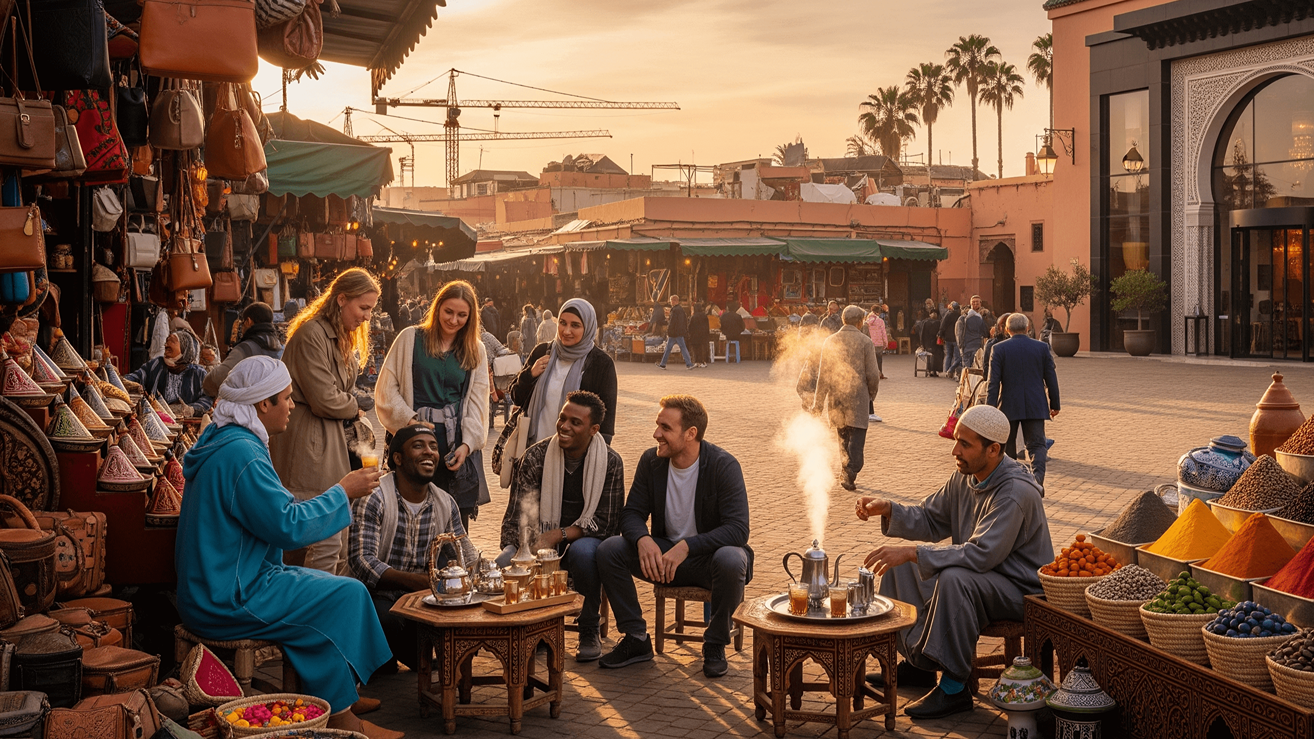
Touristic investment Morocco 2026 enters a structurally distinct phase. Morocco welcomed 19.8 million tourists in 2025, a 14% increase over 2024 and a new national record (Ministry of Tourism / Xinhua, January 2026). Tourism revenues reached MAD 124 billion (approximately USD 13.6 billion) through November 2025, up 19% year-on-year (Ministry of Tourism, January 2026). Tourism GDP reached MAD 116.2 billion in 2024, a 38.4% increase over 2019, raising the sector's contribution to 7.3-7.4% of national GDP (HCP / Ministry of Tourism, 2025). The sector directly employs approximately 880,000 people, representing roughly 5% of total national employment (Ministry of Tourism / Xinhua, 2026). Total lodging capacity exceeded 304,000 beds as of late 2025, with 43,000 beds added in two years (SMIT, December 2025). Morocco ranked second in Africa for tourism foreign direct investment over the 2015-2024 period, with greenfield tourism investments totaling USD 2.6 billion during that window (SMIT / UN Tourism, 2024). Tourism was the third-largest FDI recipient sector in Morocco between 2007 and 2023, capturing 9.1% of total FDI inflows (Office des Changes, 2024). The year 2026 marks a convergence: the GoSiyaha subsidy program closes, the 2023-2026 Tourism Roadmap enters its final execution year, and preparation for the 2030 FIFA World Cup shifts from planning to physical delivery. For international investors, the current period represents a closing window of public subsidy access and an opening window of structural demand formation.
Market Overview: GDP Contribution, Receipts, and Structural Reforms
Morocco's tourism sector has undergone a measurable structural recovery and expansion since 2019. Tourism GDP rose from MAD 84 billion in 2019 to MAD 116.2 billion in 2024, reflecting a compound annual growth rate significantly above the national economy's overall trajectory. The sector's contribution to GDP increased from approximately 6.3% in 2019 to 7.3-7.4% in 2024 (HCP / Ministry of Tourism, 2025). Tourism receipts through November 2025 reached MAD 124 billion, a 19% increase over the equivalent period in 2024 (Ministry of Tourism, January 2026). Morocco's broader GDP growth is forecast at 4.0% for 2025 and 3.6% for 2026 (World Bank / IMF projections), providing a stable macroeconomic backdrop for tourism-linked capital deployment.
The institutional framework supporting Moroccan tourism investment comprises several overlapping programs. The Tourism Roadmap 2023-2026 allocated USD 610 million (MAD 6.1 billion) in public spending to accelerate capacity expansion, infrastructure improvement, and demand diversification. The roadmap's 2030 targets are explicit: 26 million tourists, MAD 150 billion or more in annual receipts, and 150,000 new hotel rooms. SMIT, the Moroccan Agency for Tourism Development, has invested in over 1,500 entertainment and experience projects since the roadmap's launch (SMIT, December 2025). SMIT's CEO Imad Barrakad stated in October 2024 that the agency is explicitly targeting hotels, theme parks, beach resorts, exhibition centers, and MICE facilities as priority investment categories.
The Investment Charter 2022 (published December 2022) provides a financial contribution of up to 30% of eligible project value, a 36-month VAT exemption on locally sourced capital equipment, and a 36-month customs duty exemption on imported equipment. These benefits apply to tourism projects structured through SMIT investment agreements. The GoSiyaha Program, managed by Agence Maroc PME (ANMPE) and launched in February 2024, allocates a MAD 720 million envelope targeting 1,700 tourism businesses by end-2026. It offers investment subsidies of 35% for tourism animation projects and 30% for associated lodging, within an investment range of MAD 1-10 million per project. As of late 2025, approximately 1,000 beneficiaries had been supported, leaving roughly 700 places before the program closes at the end of 2026. This program also includes technical assistance and green growth support arms. The Cap Hospitality Fund provides bank loans of MAD 3-100 million with state-covered interest, maximum 12-year maturity, and up to a 2-year grace period, specifically for acquisition of existing tourism establishments. SMIT offers a direct subsidy of up to 30% of investment value for qualifying tourism projects.
The 2030 FIFA World Cup co-hosted by Morocco, Spain, and Portugal introduces a structural demand catalyst distinct from event-year tourism alone. Morocco's national investment package for World Cup preparation totals MAD 42 billion (approximately USD 4.4 billion) (2024). The Grand Stade Hassan II near Benslimane carries an estimated cost of MAD 5 billion (approximately USD 520 million) and will seat over 115,000 spectators. Airport capacity is being doubled to 90 million passengers annually by 2035, with expansion underway at Marrakech, Casablanca, and Agadir airports. Royal Air Maroc is targeting a fleet of 200 aircraft by 2037. These are not contingent plans; they represent committed public capital with construction timelines already in execution. SMIT has set a target for FDI share in tourism investment to rise from 20% to 30% by 2026.
Regional and Value Chain Breakdown
Marrakech-Safi: High-Yield Core Market with Saturation Risk
Marrakech-Safi remains Morocco's dominant tourism region by arrivals, revenue, and brand recognition. The city of Marrakech alone captures a disproportionate share of international overnight stays, and the region benefits from dense hotel inventory, a well-connected international airport, and year-round cultural programming. Value chain strengths concentrate in luxury accommodation, cultural tourism, and increasingly, experiential and digital tourism platforms. Major international hotel brands maintain flagship properties here; the region has served as the primary entry point for GCC and European hotel investment in Morocco.
The concentration challenge is well-documented. Minister of Tourism Fatim-Zahra Ammor has explicitly cited geographic concentration of arrivals as a strategic challenge requiring policy correction. Marrakech's share of total national arrivals, while beneficial for occupancy rates and yield, constrains Morocco's ability to scale tourism GDP without creating congestion, pricing pressure on real estate, and overtourism strain on heritage infrastructure. Investment Charter and GoSiyaha subsidies are technically available in Marrakech-Safi, but SMIT's priority incentive allocation increasingly favors secondary destinations. For investors, Marrakech remains the highest-yield market for luxury and boutique lodging but presents competitive entry barriers, elevated land costs, and lower subsidy prioritization. The entertainment and leisure segment is underdeveloped relative to the visitor base, which creates a specific opportunity for theme parks, leisure parks, and evening entertainment complexes serving an audience that currently has limited non-hotel, non-restaurant spending options.
Souss-Massa (Agadir Coast): Scale, Airport Access, and Year-Round Demand
The Souss-Massa region, centered on Agadir and its Atlantic coastal corridor, offers Morocco's most scalable tourism investment environment. Agadir Al Massira Airport is undergoing expansion as part of the national airport capacity program. The region benefits from a long tourism season relative to other Moroccan destinations, with significant European charter traffic during winter months and growing domestic demand. Beach resort infrastructure is well-established but aging in parts, creating a conversion and upgrading opportunity alongside greenfield development.
Value chain positioning includes mid-scale and upscale accommodation, beach and resort complexes, aquatic entertainment, eco-tourism (particularly in the Souss-Massa National Park corridor and the Arganeraie Biosphere Reserve), and emerging MICE capacity. Agadir has been identified by SMIT as a priority destination for entertainment and leisure complexes, specifically because the existing offer is heavily concentrated in all-inclusive beach hotels without adequate ancillary entertainment or cultural programming. GoSiyaha's 35% animation subsidy is directly relevant here, as projects that extend visitor length of stay through entertainment diversification align precisely with the program's objectives. Infrastructure access is strong: highway connection to Marrakech (approximately 2.5 hours), expanding airport, and port access. Investment bottlenecks include land acquisition for greenfield projects, which requires SMIT investment agreements for state-owned coastal plots and strict construction delivery timelines. Seasonality, while less severe than in northern Morocco, remains a factor; MICE and wellness segments provide a partial offset.
Tanger-Tétouan-Al Hoceïma: European Proximity, MICE Growth, and Port-Linked Tourism
The northern region of Tanger-Tétouan-Al Hoceïma occupies a unique positioning in Morocco's tourism investment landscape. Tangier sits 14 kilometers from Spain across the Strait of Gibraltar, served by ferry connections and an expanding international airport. Tanger Med port, one of the largest container ports in Africa, drives business travel demand. The region's tourism offer includes coastal leisure (Mediterranean beaches from Al Hoceïma to Fnideq), cultural tourism (Tangier's medina, Tetouan's UNESCO-listed old town), and emerging MICE demand linked to the broader Tangier economic zone.
Tangier's MICE infrastructure is growing but remains undersized relative to its business traveler base. Convention and congress facilities capable of hosting international-scale events are limited. The World Cup will bring matches and spectators to northern Morocco, generating direct infrastructure investment and post-event legacy assets. Hotel investment in the 4-star and 5-star categories has accelerated, with several international brands entering or expanding. Al Hoceïma, further east along the Mediterranean, remains an early-stage market with significant eco-tourism and boutique lodging potential, though it faces access constraints (limited direct international air connections). Investment in the Tangier corridor benefits from CRI (Regional Investment Center) support, proximity to European source markets, and the government's strategic interest in rebalancing tourism away from the Marrakech-Agadir axis.
Oriental and Southern Atlantic (Dakhla-Laâyoune-Sakia El Hamra): First-Mover Advantage in Undeveloped Coastal Markets
The Oriental region (centered on Oujda, Saïdia, and Nador) and the southern Atlantic coastline (Dakhla, Laâyoune) represent the earliest-stage investment geographies in Moroccan tourism. Dakhla in particular has attracted significant attention from both GCC sovereign investors and European adventure-tourism operators. The town offers a lagoon environment suited to water sports (kitesurfing, windsurfing), year-round warm climate, and a coastal profile that has drawn comparisons to early-stage coastal resort development in the Gulf and East Africa.
State investment in Dakhla is accelerating. Infrastructure projects include airport expansion, road access improvements, and port development. The government has expressed explicit interest in attracting Gulf investment to the Dakhla corridor for mixed-use resort and leisure development. The region's eco-tourism and adventure tourism positioning aligns with GoSiyaha green growth support. However, investment risks are material: limited existing hospitality infrastructure, long distances from primary European source markets (though direct flights from some European cities operate seasonally), workforce availability constraints, and supply chain costs for construction materials. The Oriental region (Saïdia, Nador) faces similar early-stage challenges, though Saïdia's beach infrastructure and marina have seen previous investment phases. For investors with appropriate risk appetite and a 7-10 year horizon, these regions offer first-mover positioning in markets where state investment is front-running private capital, a dynamic that can create value for early entrants willing to structure around the available subsidy instruments.
Morocco Hotel Investment and Accommodation Capacity
Morocco's accommodation sector is the largest investment segment within tourism, and the capacity gap remains substantial. Total lodging capacity exceeded 304,000 beds as of late 2025 (SMIT, December 2025), but meeting the 2030 target of 150,000 new hotel rooms implies a significant acceleration in development pace. Over 150 international hotel brands currently operate in Morocco. The greenfield development pipeline is concentrated in Marrakech, Agadir, and Tangier, though SMIT is actively steering investment toward Fès, Essaouira, Dakhla, and the Mediterranean coast.
The Investment Charter provides up to 30% financial contribution for eligible hotel projects structured through SMIT agreements. GoSiyaha's 30% lodging subsidy (for investments of MAD 1-10 million) targets small and mid-scale lodging, including boutique hotels, guest houses, and eco-lodges. The Cap Hospitality Fund addresses a different segment entirely: acquisition and rehabilitation of existing classified establishments, with loans of MAD 3-100 million at state-subsidized interest rates. For mid-scale and luxury hotel investors, the combination of Investment Charter grants, VAT exemptions, customs duty exemptions, and SMIT direct subsidies creates a blended incentive layer that can materially reduce equity requirements when structured correctly.
Typical investor profiles for hotel development include GCC sovereign wealth funds (with a preference for luxury and resort properties), international hotel groups expanding through management contracts, European private equity firms targeting mid-scale and lifestyle brands, and Moroccan family offices deploying capital into regional markets. Entry barriers vary by segment: luxury greenfield projects require SMIT investment agreements and face land allocation processes with delivery schedule covenants; boutique and conversion projects carry lower capital intensity but require careful regulatory navigation.
Morocco Entertainment Projects and Leisure Complexes
Entertainment and leisure is the most structurally undersupplied segment in Moroccan tourism. SMIT has identified this gap explicitly. CEO Imad Barrakad stated in October 2024 that the agency targets theme parks, leisure parks, aquatic centers, gaming and entertainment centers, and beach resorts as priority categories for new investment. The rationale is economic: Morocco's average visitor length of stay and per-visitor spend are constrained by the limited range of paid entertainment options outside of accommodation and dining. Extending average stay by even one night through entertainment diversification generates significant incremental revenue across the tourism value chain.
GoSiyaha's 35% investment subsidy for tourism animation projects directly supports this segment. The subsidy applies to investments of MAD 1-10 million, covering entertainment parks, cultural attractions, adventure activity centers, and experiential tourism installations. SMIT has invested in over 1,500 entertainment and experience projects since the 2023-2026 roadmap launch (SMIT, December 2025), indicating both the scale of the gap and the institutional commitment to closing it. For international investors, the entertainment segment offers several characteristics: lower competitive density than hotel development, explicit government support, alignment with demand diversification strategy, and relatively favorable subsidy terms. Capital intensity varies widely, from MAD 5-10 million for adventure tourism operations to MAD 500 million or more for full-scale theme parks. Margin profiles in entertainment tend to be higher than in accommodation once stabilized occupancy is achieved, though pre-operating investment and ramp-up periods are longer.
This segment aligns particularly well with World Cup 2030 preparation. The expected influx of 2-3 million additional visitors during the tournament period will generate concentrated demand for non-match entertainment. Post-event, entertainment assets designed for year-round use retain value more effectively than single-purpose sports infrastructure.
MICE Infrastructure: Conferences, Exhibitions, and Business Tourism
Morocco's MICE (meetings, incentives, conferences, exhibitions) segment is underdeveloped relative to the country's arrivals base and its positioning as Africa's second-largest tourism FDI destination. While Marrakech hosts international conferences and Casablanca has expanding business tourism demand, purpose-built convention centers and congress facilities meeting international standards remain limited outside of a few flagship properties. Tangier and Agadir lack dedicated MICE infrastructure at the scale required to attract large international events on a consistent basis.
The World Cup will accelerate MICE infrastructure development through stadium precincts designed for post-event conversion to multi-use event and exhibition spaces. However, private-sector MICE investment beyond the stadium precincts is required to capture the post-2030 business tourism opportunity. SMIT has included exhibition centers and congress facilities in its priority investment categories. For investors, MICE infrastructure offers lower seasonality exposure than beach or resort tourism, higher repeat-visitor economics, and alignment with Morocco's growing role as a host for African continental summits, trade events, and corporate gatherings. Entry models include standalone convention center development, MICE-integrated hotel projects, and multi-use event complexes combining conference, exhibition, and entertainment functions.
Eco-Tourism, Adventure Tourism, and Cultural Experiences
Morocco's geographic and cultural diversity supports a differentiated eco-tourism and adventure tourism offer. The Atlas Mountains, Sahara desert circuits, Atlantic and Mediterranean coasts, and UNESCO World Heritage cities (Fès, Essaouira, Meknès, Tetouan) provide the raw inputs. Dakhla's lagoon has become a globally recognized water sports destination. The Arganeraie Biosphere Reserve and multiple national parks provide frameworks for nature-based tourism development.
GoSiyaha includes a green growth support arm specifically designed for eco-tourism ventures. The 35% animation subsidy applies to adventure and nature-based tourism projects within the MAD 1-10 million range. Growing demand from European and GCC travelers for experiential, sustainability-oriented travel aligns with this segment. Entry barriers are relatively low compared to hotel or entertainment development, though profitability depends on visitor volume and season extension. Agri-tourism and cultural experience platforms, connecting visitors with local agricultural production, craft traditions, and culinary heritage, represent an adjacent segment with growing international demand and alignment with Morocco's rural development objectives.
Tourism Technology and Digital Platforms
SMIT has embedded a digitalization mandate within the 2023-2026 roadmap. Booking infrastructure, destination management systems, visitor analytics, and digital marketing platforms are targeted for upgrade. The Airbnb and alternative accommodation platform segment has grown materially in Morocco, particularly in Marrakech and Essaouira, creating both competitive pressure on traditional hotels and new platform opportunities for property management, guest experience, and regulatory compliance technology.
For technology investors and platform operators, the opportunity is structural: Morocco's tourism sector is digitizing rapidly but unevenly, with significant gaps in real-time inventory management, dynamic pricing, and integrated experience booking. Capital intensity is lower than in physical infrastructure segments, but monetization depends on achieving scale across a fragmented market of small operators. Investors in this segment should consider how technology platforms intersect with Smart.by's innovation advisory practice, particularly in destination management and sustainability reporting frameworks.
Regulatory Environment and Incentive Architecture
Morocco permits 100% foreign ownership in private tourism companies. There is no nationality restriction on investment under the Investment Charter 2022. Land acquisition for tourism projects involving state-owned or public land requires investment agreements with SMIT, which include approved construction programs and delivery schedule covenants. Failure to meet construction deadlines can result in cancellation of the land allocation. This mechanism protects against speculative land banking but imposes execution discipline on investors.
The incentive architecture for tourism investment in Morocco is multi-layered:
- Investment Charter 2022: Financial contribution up to 30% of eligible project value; 36-month VAT exemption on locally sourced capital equipment; 36-month customs duty exemption on imported equipment. Applicable to tourism projects through SMIT investment agreements.
- GoSiyaha Program (MarocPME, 2024-2026): Investment subsidy of 35% for tourism animation and entertainment projects; 30% for associated lodging. Investment range of MAD 1-10 million. Technical assistance arm for project preparation. Green growth arm for eco-tourism. Approximately 700 beneficiary slots remaining as of late 2025. Program closes at end-2026.
- SMIT Direct Subsidy: Up to 30% of investment value for qualifying tourism projects outside of the GoSiyaha framework.
- Cap Hospitality Fund: Bank loans of MAD 3-100 million with state-covered interest; maximum 12-year maturity; up to 2-year grace period. Specifically for acquisition or rehabilitation of existing classified tourism establishments.
- Profit Repatriation: Fully permitted for current account transactions since 2018 (Bank Al-Maghrib). Morocco's exchange regime allows free transfer of dividends, management fees, and capital gains upon exit, subject to standard documentation with authorized intermediary banks.
- Regional Investment Centers (CRI) and Regional Development Companies (SDR): Provide additional regional incentive structures, land access facilitation, and administrative support for investment projects at the regional level.
Corporate tax rates in Morocco follow the general regime: a progressive scale applies to domestic companies, with rates varying by taxable profit bracket. Tourism-specific exemptions may apply in designated development zones, but the precise current rates and zone-specific exemptions should be confirmed with the Direction Générale des Impôts, as schedules have been adjusted in recent finance laws [DATA GAP — VERIFY current IS rate schedule and any tourism-specific zone exemptions for 2025-2026].
In comparative context, Morocco's combined incentive offering competes favorably with regional peers. Egypt offers investment zone incentives but with more complex regulatory navigation. Tunisia provides incentive structures but faces lower tourism growth momentum. Kenya targets tourism investment through Special Economic Zones but with less mature subsidy instruments for small and mid-scale projects. Spain, as a co-host of the 2030 World Cup, offers sophisticated capital markets access but lacks the subsidy intensity available in Morocco for greenfield tourism development. Morocco's positioning as the second-ranked African destination for tourism FDI (SMIT / UN Tourism, 2024) reflects this competitive incentive environment combined with political stability, geographic proximity to Europe, and improving air connectivity.
Risk Considerations for Investors
Geographic Concentration of Arrivals. Marrakech captures a disproportionate share of Morocco's international tourist arrivals. This concentration creates pricing pressure, overtourism strain on heritage assets, and a vulnerability to any single-destination shock. Minister Ammor has cited this explicitly as a strategic challenge. Mitigation is active: SMIT's incentive allocation increasingly prioritizes secondary destinations (Agadir, Fès, Dakhla, Tangier, Essaouira). The Tourism Roadmap 2023-2026 includes a specific mandate to redistribute tourism flows. For investors, this means that projects outside Marrakech may access more favorable subsidy terms, but also that Marrakech's yield premium reflects real demand concentration that is unlikely to dissipate within the investment horizon.
Post-Event Demand Sustainability. The 2030 target of 150,000 new hotel rooms raises a legitimate question about post-World Cup overcapacity. If the room stock is designed primarily for event-year absorption without year-round demand viability, investors face occupancy risk from 2031 onward. Oxford Economics Africa and DLA Piper have flagged this risk explicitly in published analysis. Mitigation: SMIT emphasizes multi-use design requirements in investment agreements, non-European market diversification (particularly targeting African and GCC source markets), and entertainment/MICE integration to support year-round demand. Investors should stress-test financial models against conservative post-2030 occupancy scenarios.
Infrastructure and Delivery Risk. Greenfield tourism zones, particularly in the north and south, involve land transfers from the state that are conditional on investment agreements with strict construction deadlines. Failure to meet delivery schedules risks cancellation of the land allocation. This mechanism disciplines execution but also creates risk for investors encountering construction delays, permitting bottlenecks, or supply chain disruptions. Northern and southern greenfield zones are state-led developments with timelines driven by public policy objectives, not purely market dynamics.
Seasonality and Demand Volatility. Coastal tourism markets in Morocco are highly seasonal, with European charter demand concentrated in October-April (for Atlantic coast) and June-September (for Mediterranean coast). Occupancy rates outside peak periods can drop materially. MICE, cultural tourism, and entertainment segments provide partial offsets, but investors in pure beach-resort assets should model seasonality explicitly.
Currency Exposure. The Moroccan dirham (MAD) is partially pegged to a basket of euro and US dollar. Current account convertibility has been in place since 2018, and Bank Al-Maghrib has conducted gradual widening of the fluctuation band. Full float is not yet implemented. Investors earning revenues in MAD and reporting in USD or EUR face exchange rate risk, though the partial peg limits volatility relative to fully floating African currencies. Further liberalization is planned but has proceeded cautiously.
Subsidy Dependency and Program Expiry. GoSiyaha closes at the end of 2026. Investors who enter after program expiry lose access to the 35% animation grant and 30% lodging subsidy. The Investment Charter and SMIT direct subsidies will remain available post-2026, but the GoSiyaha layer specifically targeting small and mid-scale entertainment and lodging projects is time-bounded. Furthermore, GoSiyaha and related subsidy programs depend on annual budget allocation; fiscal tightening could constrain future program renewals.
Skilled Labor Gaps. The tourism sector directly employs 880,000 people (Ministry of Tourism / Xinhua, 2026). The target of 150,000 new hotel rooms implies a requirement for tens of thousands of additional hospitality workers across housekeeping, food and beverage, front office, management, and specialized entertainment operations. Morocco's hospitality training capacity is under strain. Investors in labor-intensive segments (large hotels, entertainment complexes) should factor workforce recruitment and training costs into project economics.
Fiscal Pressure. Morocco's gross public debt has risen, and the MAD 42 billion World Cup infrastructure commitment adds to fiscal obligations. The IMF Flexible Credit Line was renewed in 2024, reflecting continued international confidence but also the scale of external financing requirements. Risk of fiscal tightening post-2030 could affect subsidy program renewals, public infrastructure co-investment, and the pace of regulatory reform. Investors with long-dated exposure should monitor Morocco's fiscal trajectory alongside sectoral dynamics.
Strategic Recommendations for International Investors
Timing and Subsidy Window. GoSiyaha's expiry at end-2026 creates a defined, non-renewable subsidy window. Investors who commit capital and submit compliant project dossiers before year-end 2026 can access 35% animation grants and 30% lodging subsidies through the program. Approximately 700 beneficiary slots remain. This is a structural, time-bounded incentive that materially reduces equity requirements for qualifying projects. Delay beyond 2026 forecloses access to this specific instrument.
Entry Structure Selection. Joint ventures with established Moroccan operators are advisable for heritage, cultural, and agri-tourism assets, where local knowledge, community relationships, and regulatory familiarity create value. Full foreign ownership greenfield structures are more appropriate for entertainment and leisure complexes, where operational IP and brand control justify sole ownership. Acquisition of existing classified establishments through the Cap Hospitality route (MAD 3-100 million, state-covered interest, 12-year maturity) provides an alternative entry path with lower execution risk than new construction, particularly in established markets like Marrakech, Fès, and Agadir.
Regional Prioritization. Agadir and Souss-Massa offer the strongest combination of scale, airport access, year-round demand, and subsidy availability for hotel and entertainment investment. Tangier provides proximity to European source markets, growing MICE demand, and World Cup preparation momentum. Dakhla and the southern Atlantic corridor offer first-mover advantage in an undeveloped coastal market with explicit state and GCC investment interest, though with higher execution risk. Marrakech remains the highest-yield market for luxury and boutique lodging but faces competitive entry barriers, saturation risk, and lower subsidy prioritization by SMIT. Investors should match regional choice to risk appetite, capital structure, and target segment.
Capital Structuring. Blended finance structures combining Investment Charter grants (up to 30%), GoSiyaha subsidies (35% animation / 30% lodging), and Cap Hospitality debt (state-covered interest) can reduce equity requirements by 40-55% for qualifying projects. This is not a theoretical exercise; it requires precise structuring of the project dossier to qualify under multiple overlapping programs without double-counting eligible costs. Phased construction sequencing aligned with SMIT delivery agreements allows investors to demonstrate execution capacity before committing full capital.
Government Negotiation Strategy. SMIT acts as the primary institutional interface for tourism investment in Morocco. AMDIE provides additional support for foreign direct investment, and Regional Investment Centers (CRI) facilitate administrative processes at the regional level. Investment agreement terms covering land allocation, subsidy disbursement, construction timelines, and operating commitments require expert negotiation. The public-private committee (CPP) structure under GoSiyaha reviews and approves project dossiers; well-prepared applications with bankable financial models and clear implementation timelines receive prioritized treatment. Investors unfamiliar with Moroccan institutional processes benefit materially from advisory support in this negotiation.
Entertainment and Leisure: Optimal Timing. This is the most structurally undersupplied segment in Moroccan tourism. The government has explicitly signaled demand for theme parks, leisure parks, aquatic facilities, and gaming entertainment centers. GoSiyaha's 35% animation subsidy directly supports this category. Entry while the subsidy is live (before end-2026) is optimal. Projects should be designed around visitor-stay extension economics: entertainment assets that add one incremental night to average visitor stay generate revenue across accommodation, food, transport, and retail value chains, creating a multiplier effect that supports project-level returns.
Phased Entry Model. Phase 1: Anchor project in a single priority region (lodging or entertainment), leveraging available grants to reduce equity exposure and establish operational track record. Phase 2: Platform expansion across additional regions, using demonstrated execution capacity to secure further SMIT support, brand partnerships, and operating efficiencies. Phase 3: Integration with MICE, cultural tourism, or digital platform segments for yield diversification and reduced seasonal exposure. This phased approach matches Morocco's institutional preference for investors who demonstrate commitment through execution before scaling.
Smart.by LLC Advisory Role
Smart.by LLC operates as a strategic investment advisory firm headquartered in Tangier, with over MAD 4 billion in facilitated capital deployment across tourism, industrial manufacturing, logistics, agro-industry, real estate, and digital transformation in Morocco and Africa. The firm advises international investors on strategy, capital structuring, feasibility, government interface, and transaction execution.
In the tourism sector specifically, Smart.by provides the following advisory capabilities aligned to the investment landscape described in this briefing:
- Research: Tourism market sizing, regional demand analysis, competitive landscape assessment, and project bankability pre-assessment. Smart.by's research function produces investor-grade analysis of site-specific demand, supply pipeline, pricing dynamics, and risk factors. Research services
- Finance: Capital structuring integrating Investment Charter grants, GoSiyaha subsidies, Cap Hospitality debt, SMIT direct support, and private equity or institutional capital. Financial model construction, sensitivity analysis, investor documentation, and fundraising support. Finance services
- Strategy: Entry structure selection (JV vs. sole ownership vs. acquisition), regional prioritization, phased development roadmaps, SMIT and government engagement strategy, and competitive positioning. Strategy services
- Innovation: Tourism technology integration, digital platform strategy, entertainment concept development, sustainability frameworks, and alignment with SMIT digitalization mandates. Innovation services
Smart.by's role is execution, not report production. The firm prepares compliant project dossiers for GoSiyaha and SMIT submission, structures subsidy applications to maximize grant capture, negotiates investment agreement terms with public counterparts, and coordinates transaction execution from feasibility through financial close. Smart.by's institutional relationships with SMIT, MarocPME, CRI, and AMDIE provide investors with direct access to the government interface required for efficient project approval and incentive disbursement.
GoSiyaha closes at the end of 2026. Approximately 700 beneficiary slots remain. Investors who require advisory support to prepare compliant project dossiers, structure subsidy applications under GoSiyaha and the Investment Charter, negotiate SMIT investment agreements, and execute capital deployment before the program expires should engage Smart.by now. The subsidy window is defined and non-renewable. Preparation of bankable dossiers, financial models, and government submissions requires lead time that cannot be compressed into the final months of program availability.
References
- Haut-Commissariat au Plan (HCP), Morocco. National accounts and tourism GDP data, 2024-2025.
- Ministry of Tourism, Handicrafts, and Social and Solidarity Economy (MTAESS), Morocco. Tourism arrivals, receipts, and employment statistics, January 2026.
- Moroccan Agency for Tourism Development (SMIT). Lodging capacity data, entertainment investment pipeline, FDI targeting, and priority investment categories. Statements by CEO Imad Barrakad, October 2024. Program data, December 2025.
- Agence Nationale pour la Promotion des Petites et Moyennes Entreprises (MarocPME / ANMPE). GoSiyaha Program details, subsidy rates, beneficiary counts, and program timeline. Launched February 2024, updated July 2025.
- Office des Changes, Morocco. FDI sectoral distribution data, 2007-2023 period. Published 2024.
- Bank Al-Maghrib. Exchange regime, current account convertibility framework, profit repatriation regulations.
- Agence Marocaine de Développement des Investissements et des Exportations (AMDIE). Investment Charter 2022, published December 2022.
- World Bank. Morocco GDP growth forecasts, 2025-2026.
- International Monetary Fund (IMF). Morocco Article IV consultation, Flexible Credit Line renewal, 2024. Fiscal and debt analysis.
- UN Tourism (UNWTO). Morocco tourism FDI ranking in Africa, greenfield investment data, 2015-2024.
- World Travel and Tourism Council (WTTC). Tourism sector economic impact analysis.
- Xinhua News Agency. Morocco tourism arrivals record reporting, January 2026.
- DLA Piper. Analysis of post-event demand sustainability and hospitality investment risk in World Cup host markets.
- Oxford Economics Africa. Tourism capacity and demand analysis for Morocco.
- African Development Bank (AfDB). Morocco infrastructure and sectoral investment analysis.