
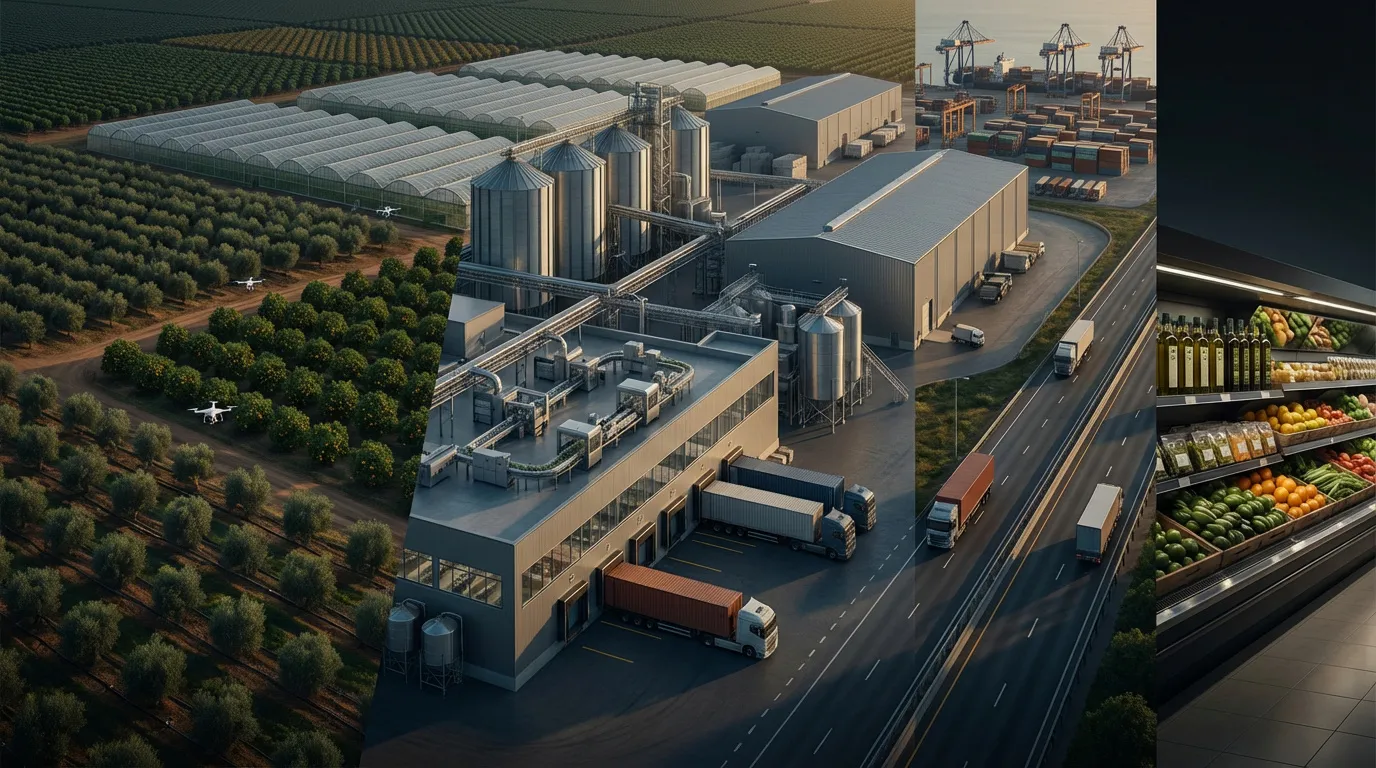
Morocco's agricultural and agri-food sector contributed between 11% and 14% of GDP over the 2020-2024 period, according to the Haut-Commissariat au Plan (HCP), with annual variation driven primarily by cereal harvest performance. The sector employs approximately 30% of the active labor force. Agri-food export revenues reached an estimated 72 to 80 billion MAD per year over the 2021-2023 period, per the Office des Changes and the Ministry of Agriculture, Maritime Fisheries, Rural Development, and Water and Forests (hereafter, Ministry of Agriculture). Agri-investment Morocco 2026 enters a structurally differentiated phase, defined by four converging forces: the acceleration of the Generation Green 2020-2030 strategy, implementation of the 2022 Investment Charter, a national push to double agro-industrial processing ratios within the decade, and the deployment of large-scale desalination infrastructure to structurally reduce drought vulnerability. Morocco cultivates approximately 8.7 million hectares of useful agricultural area (SAU), of which roughly 1.6 million hectares are irrigated. Its network of 54 free trade agreements covers markets exceeding two billion consumers, including the European Union, the United States, and the 54-member African Continental Free Trade Area (AfCFTA).
This briefing structures the investment case across three priority regions (Souss-Massa, Gharb, Fès-Meknès), the primary value chain stages (production, processing, cold chain, export logistics), and three core investment segments (export platforms, agri-food processing, agri-tech). It is intended as an institutional reference for sovereign funds, private equity firms, family offices, strategic operators, and development finance institutions evaluating Moroccan agriculture investment opportunities.
Market Overview: Structural Position and Reform Trajectory
Agriculture's contribution to Moroccan GDP has exhibited pronounced cyclicality over the past decade, oscillating between approximately 11% and 14% based on HCP annual national accounts. This variability is driven overwhelmingly by rainfed cereal production, which occupies the majority of Morocco's cultivated area but generates a disproportionately small share of export revenue. During the prolonged drought cycle spanning 2017 to 2024, cereal output fluctuated dramatically: from a near-record 10.3 million tonnes in the favorable 2020-2021 campaign to approximately 3.2 million tonnes in 2021-2022 and under 4 million tonnes in 2023-2024, per Ministry of Agriculture seasonal reports. In contrast, high-value irrigated subsectors, including citrus, tomatoes, berries, and olives, demonstrated structural resilience, sustaining export value growth even during drought-affected years.
The employment structure underscores the sector's macroeconomic weight. HCP labor force surveys place agricultural employment at approximately 30% of the total active population, or roughly 3.3 to 3.5 million individuals. However, the composition of this workforce presents both constraint and opportunity. An estimated 70% of Moroccan farms are smaller than 5 hectares, per Ministry of Agriculture census and survey data, limiting mechanization, constraining access to capital, and inhibiting integration into export-oriented value chains. Conversely, this fragmentation creates structural opportunities for aggregation, contract farming, and private equity-backed consolidation connected to downstream processing capacity.
Morocco's trade architecture provides a foundational competitive advantage for export-oriented agriculture. The EU-Morocco Association Agreement governs the majority of agricultural trade, with the EU absorbing over 60% of Morocco's fresh produce exports. The Morocco-US Free Trade Agreement, in force since 2006, offers tariff-free access for a growing range of agricultural products. Under the AfCFTA, Morocco stands to gain incremental access to continental markets, particularly for processed foods. Investors should, however, note the October 2024 ruling by the Court of Justice of the European Union (CJEU), which annulled certain EU-Morocco trade agreements as applied to Western Sahara. While this ruling primarily affects products originating in the disputed territory, and the majority of Morocco's agricultural exports are produced in undisputed regions (Souss-Massa, Gharb, Fès-Meknès, and other northern and central zones), its longer-term implications for EU-Morocco trade governance remain under negotiation and warrant monitoring.
The structural reform background is defined by two successive national strategies. Between 2008 and 2020, the Plan Maroc Vert (PMV) reshaped Moroccan agriculture, expanding drip irrigation toward approximately one million hectares, increasing agricultural GDP by an estimated 60% over the program's duration (per Ministry of Agriculture review), and establishing over 1,200 aggregation projects linking smallholders to commercial operators. The successor strategy, Generation Green 2020-2030 (Génération Green), pivots toward human capital development, value chain depth, and technology adoption. Principal targets include the emergence of approximately 400,000 new farming households into a "rural middle class," the creation of an estimated 350,000 new jobs, and a doubling of the processed share of agricultural output from approximately 12% toward a target range of 20-25%.
The 2022 Investment Charter (Dahir No. 1-22-76) introduced a modernized incentive framework applicable across sectors, including agriculture and agro-industry. The Charter establishes a common incentive base for tangible and intangible investment, complemented by territorial premiums for projects located in priority regions. For qualifying agro-industrial investments, the combined state contribution can reach up to 30% of total project cost. Regional Investment Centers (CRI), reorganized under the Charter, serve as unified interlocutors for investment licensing, permitting, and incentive adjudication, reducing the administrative friction that historically deterred international operators.
Foreign direct investment into Morocco's agriculture and agro-industry has grown in recent years, although the Office des Changes does not systematically publish sector-level FDI breakdowns for agro-industry separately from broader categories. Total FDI inflows into Morocco approximated $2 to $3.6 billion annually over the 2020-2024 period, per UNCTAD and Bank Al-Maghrib reporting, with notable growth in 2024 linked to automotive, renewable energy, and industrial scaling. Within the agricultural vertical, transaction activity has concentrated in berry cultivation, olive oil processing, citrus pack-house development, and cold chain infrastructure, with European food groups, Gulf-based agricultural platforms, and development finance institutions (including the IFC, AfDB, and European DFIs) as the most active capital sources.
Regional and Value Chain Analysis: Souss-Massa, Gharb, and Fès-Meknès
Souss-Massa: Export Horticulture Anchor and Water Innovation Frontier
Souss-Massa is Morocco's preeminent export horticulture region. The Souss plain and the Chtouka Ait Baha area produce the majority of Morocco's export tomatoes and a substantial share of its citrus, particularly clementines and mandarins grown for European winter markets. National citrus production has ranged between approximately 2.3 and 2.6 million tonnes annually over the 2020-2023 period (Ministry of Agriculture), with Souss-Massa contributing a major share. The region's semi-arid coastal climate enables year-round greenhouse and open-field production of high-value crops, including berries, avocados, green beans, and peppers. National tomato harvest volumes have reached approximately 1.4 to 1.5 million tonnes per year, with the Souss-Massa region dominant in the export segment.
Infrastructure access is strong relative to other Moroccan agricultural regions. The Port of Agadir provides direct maritime export channels, while an expanding cold chain corridor connects production zones to the Tangier Med complex and European markets via refrigerated road and sea transport. Agadir's Al Massira Airport supports air freight for ultra-perishable products, though its cargo capacity remains limited compared to Casablanca's Mohammed V Airport.
The region's principal structural risk is water. The Souss aquifer, the primary groundwater source for irrigated agriculture, has been under severe stress for over two decades due to over-extraction. The government has responded with the most significant mitigation investment in Moroccan agricultural history: the Chtouka seawater desalination plant, commissioned in 2021, provides desalinated water for irrigation across approximately 15,000 hectares of high-value farmland in the Chtouka perimeter. Production capacity is approximately 275,000 m³ per day, with distribution infrastructure connecting the plant to agricultural networks. A second phase, along with additional desalination capacity for the wider Souss-Massa area, is under planning. This positions the region as an operational model for desalination-dependent export agriculture with direct relevance across North Africa and the Middle East.
Investment bottlenecks in Souss-Massa include high land costs (both leasehold and informal transactions), competition for skilled agronomic labor, and the capital intensity of greenhouse infrastructure (typically 400,000 to 800,000 MAD per hectare for modern multi-span greenhouses, excluding water and post-harvest equipment). Preferred entry modes include acquisition of existing operational farms, joint ventures with established Moroccan grower-exporters, or development of integrated pack-house and cold chain facilities that aggregate output from multiple producers.
Gharb: Morocco's Highest-Potential Agricultural Basin
The Gharb plain, centered on the city of Kenitra, is one of Morocco's most productive agricultural zones and arguably its most water-secure. The region benefits from the Sebou River basin, Morocco's largest in terms of water volume, and from dam-fed irrigation infrastructure that provides relative stability even during drought cycles. Principal crops include sugar beet, rice (Morocco's primary rice-growing zone), citrus, soft fruits (strawberries and other berries), and cereals. The region also supports significant livestock production.
The Gharb's competitive advantage for investors lies in the combination of water availability, flat topography suitable for mechanization, proximity to Kenitra and Casablanca logistics corridors, and access to a growing industrial base. The Atlantic Free Zone near Kenitra is a major industrial platform with established infrastructure for manufacturing and processing. While currently focused on automotive and aerospace, adjacent food processing capacity is under development. The Gharb benefits from direct highway connections to Tangier Med, Morocco's largest container port, via the A1 motorway, with transit times of approximately 2.5 to 3 hours.
Sugar beet processing in the Gharb is dominated by Cosumar, Morocco's national sugar refining group (Al Mada Holding). Cosumar's operations in the region provide a stable off-take anchor for primary sugar beet producers, and the contractual farming model applied by Cosumar (providing seed, inputs, and guaranteed purchase prices) offers a reference case for aggregation-based investment models in other crops. The region's berry sector, particularly strawberries produced in the Larache and Moulay Bousselham areas adjacent to the Gharb, has grown rapidly, with output increasingly directed toward both domestic processing (frozen and semi-processed strawberries) and EU export.
Investment opportunities in the Gharb include large-scale irrigated production (greenfield and expansion), food processing facilities (sugar, juice, dairy), and cold chain development serving the Kenitra-Casablanca corridor. The CRI of the Rabat-Salé-Kenitra region serves as the designated investment interface. Risk factors in the Gharb are comparatively moderate: water security is higher than in Souss-Massa, and soil quality is generally favorable. The principal challenges include flood risk during heavy rainfall seasons (the Gharb plain is naturally flood-prone), the labor intensity of berry and vegetable production, and the informality of certain land market segments. Investors should conduct thorough due diligence on land title, as customary "melk" tenure can involve fragmented or disputed ownership records.
Fès-Meknès: Olive Economy and Food Processing Industry Growth
The Fès-Meknès region is Morocco's traditional heartland for olive cultivation, grain production, and viticulture. Morocco ranks among the world's five largest olive producers, with national production estimated at approximately 1.9 to 2.1 million tonnes of olives annually (FAO and Ministry of Agriculture data, 2022-2023). The Meknès-Saïss plain accounts for a significant share of this output, particularly table olives and olive oil. Moroccan olive oil exports have grown, though the country's global market share remains below what its production volume would imply, partly due to quality grading, branding deficits, and limited cold-pressed and organic certification penetration.
The food processing industry in the Fès-Meknès region is an emerging growth segment. The agro-industrial base includes olive oil mills, flour and cereal processing, canning facilities (olives, preserved vegetables), and a growing segment of aromatic and medicinal plant extraction (thyme, rosemary, and argan-adjacent products). Several public-private industrial zones in the Fès and Meknès peripheries offer serviced land at competitive rates, with CRI Fès-Meknès functioning as the designated investment interface. The region's labor costs are among the lowest in Morocco, and its labor pool includes graduates from regional universities with agricultural and food science programs, including the École Nationale d'Agriculture de Meknès (ENA Meknès).
Investment bottlenecks in Fès-Meknès include relatively long distances from major export ports (Tangier Med is approximately 300 km from Fès, Casablanca approximately 250 km), the historical dominance of smallholder olive farming (limiting consolidation without aggregation frameworks), and infrastructure gaps in cold storage within interior zones. Export orientation is lower than in Souss-Massa, and the region's value proposition centers on processing margin capture rather than primary export of fresh produce. For investors targeting olive oil upgrading, preserved foods, or grain-based processing, Fès-Meknès offers lower land and labor costs than coastal regions, a deep agricultural supply base, and improving industrial infrastructure.
Cold Chain and Export Logistics: Cross-Regional Infrastructure
Morocco's cold chain infrastructure has expanded significantly over the past decade but remains insufficient relative to the volume and value of perishable agricultural output. Post-harvest losses for fresh produce are estimated at 20-30% for certain product categories, according to FAO and World Bank assessments of North African supply chains. The Generation Green strategy explicitly targets cold chain expansion as a priority for value preservation and export competitiveness.
Current cold storage capacity is concentrated around Agadir, Casablanca, and Tangier, with smaller facilities in Kenitra, Meknès, and Nador. Tangier Med, which handles the majority of Morocco's containerized maritime trade and provides direct roll-on/roll-off ferry access to European ports (Algeciras, Barcelona, Marseille), is the primary logistics gateway for fresh produce destined for EU markets. Transit times from Tangier Med to southern Spain average 30 to 90 minutes by ferry; from Agadir to Tangier Med, approximately 9 to 12 hours by refrigerated truck. Casablanca's port and Mohammed V Airport serve as secondary export nodes, with the airport handling higher-value air freight for berries, cut flowers, and ultra-premium horticulture.
Investment in cold chain infrastructure represents one of the lower-risk, highest-demand segments of Morocco's agricultural value chain. Entry barriers are moderate (largely related to land acquisition near ports and regulatory compliance), capital requirements are significant but bankable (cold storage facilities typically require 20 to 60 million MAD per unit depending on scale and technology), and revenue models are stabilized by growing demand from both domestic and export-oriented growers. The segment is attractive to infrastructure-focused private equity, DFIs, and strategic logistics operators seeking exposure to Moroccan agricultural growth without direct production risk.
Investment Opportunities by Segment
Export Platforms: Integrated Production-to-Market Systems
The highest-growth segment of Moroccan agriculture investment involves integrated export platforms: operations that combine primary production (typically irrigated horticulture), post-harvest processing (washing, sorting, grading, packing), cold storage, and direct logistics to European or other destination markets. Morocco's export horticulture sector has grown at a compound annual rate estimated at 6-9% in value terms over the 2015-2023 period, driven by citrus, tomatoes, berries (blueberries, raspberries, strawberries), avocados, and green beans.
Berry cultivation has been one of Morocco's fastest-growing agricultural subsectors. Blueberry and raspberry production, concentrated in the Souss-Massa and Gharb-adjacent (Larache/Kenitra) areas, supplies European markets during winter counter-seasonal windows. Morocco is now among the world's largest exporters of fresh berries to Europe, competing directly with Spain, Portugal, and Peru. Entry into this segment requires substantial upfront capital: greenhouse infrastructure, irrigation systems, varietal licensing (typically through breeding programs based in the EU or the US), and pack-house capacity. Per-hectare development costs range from 500,000 to 1,200,000 MAD for fully equipped berry operations. Gross margins are attractive, estimated at 30-45% at farm gate for well-managed operations, but the segment requires strong agronomic management, varietal access, and established buyer relationships with EU retail chains.
Typical investor profiles for export platforms include strategic operators (European fresh produce companies or grower-shippers expanding production into Morocco), agricultural private equity funds, and Gulf-based food security platforms. Joint ventures with established Moroccan grower-exporters remain the most efficient entry structure, providing access to land, labor, water allocations, and established export logistics without the greenfield development timeline of two to three years.
Morocco Agro-Industry: Processing Capacity and Value Addition
Agro-industrial processing is the segment where Morocco's investment case is arguably strongest in risk-adjusted terms. The country processes only approximately 12% of its agricultural output (Ministry of Agriculture estimate under the Generation Green baseline), compared to 40-60% in mature agricultural economies such as Spain or France. Closing this processing gap represents a multi-billion-MAD investment opportunity across several product categories: olive oil refining and bottling, fruit and vegetable canning, juice concentrate production, frozen produce (particularly berries and vegetables), dairy processing, sugar and confectionery, and aromatic and medicinal plant extraction.
Morocco agro-industry benefits from structural cost advantages including competitive labor costs (the SMIG, or minimum industrial wage, stood at approximately 3,111 MAD per month as of 2024), proximity to EU markets delivering transit time advantages over competing origins, and the tariff preferences conferred by existing trade agreements. Capital intensity varies by subsector: a mid-scale olive oil processing and bottling facility may require 15 to 40 million MAD, while a multi-product canning or freezing facility serving export markets can range from 50 to 200 million MAD depending on throughput capacity and technology specification.
Margin profiles in processing are typically more stable than in primary production, as processors can source from multiple farms, diversify product lines, and reduce weather-related volatility. Key regulatory considerations include the requirement to obtain sanitary and phytosanitary certification from ONSSA (Office National de Sécurité Sanitaire des Produits Alimentaires), EU HACCP compliance for export-oriented facilities, and organic certification where applicable (through bodies recognized by the EU and USDA). The segment is suited to industrial private equity, strategic food companies seeking to integrate Moroccan supply, and development finance institutions with mandates in agro-industrial value addition.
Cold Chain Infrastructure: Investable Gap
As detailed in the regional analysis, Morocco's cold chain capacity presents a quantifiable and bankable investment gap. The discrepancy between growing export volumes of perishable products and available cold storage, pre-cooling, and refrigerated transport capacity creates sustained demand for infrastructure capital. This segment is characterized by predictable revenue streams (lease or fee-for-service models), moderate technology risk, and eligibility for both Investment Charter incentives and DFI concessional financing. Pre-cooling stations near production zones, multi-temperature storage facilities near ports, and refrigerated transport fleet expansion are all capital-deployable opportunities. DFIs, infrastructure private equity, and logistics operators represent the primary investor base for this segment.
Agri-Tech and Precision Agriculture
Morocco's agri-tech segment is nascent but growing, driven by three demand-side forces: water scarcity creating urgency for precision irrigation and soil moisture monitoring; labor cost pressures incentivizing mechanization and automation; and export quality requirements demanding traceability, residue management, and digital supply chain integration. The Generation Green strategy explicitly promotes technology adoption, and several international agri-tech companies have established pilot operations in Morocco.
Investable subsegments include precision irrigation systems (drip technology, sensor-based scheduling), drone-based crop monitoring, soil analytics platforms, farm management software, post-harvest quality assurance technology (optical sorting, automated grading), and cold chain monitoring using IoT-enabled temperature tracking. Capital requirements are generally lower than for primary production or processing: technology ventures serving the Moroccan market may require 5 to 30 million MAD for local operations. Commercial models are less proven in the Moroccan context than in more digitized agricultural markets. Early-stage venture capital, impact investors, and corporate venture arms of agri-input companies are the most active capital providers. The CRI network and AMDIE's innovation support programs facilitate regulatory navigation and pilot-phase structuring for technology-driven entrants.
Regulatory Environment and Incentive Architecture
Morocco's regulatory framework for agricultural investment combines open foreign ownership rules for industrial and commercial assets with specific constraints on agricultural land. Foreign investors can hold 100% equity in agro-industrial processing companies, trading entities, and technology firms without sector-specific ownership limitations. The 2022 Investment Charter does not impose equity ceilings for the agro-industrial sector. Direct foreign ownership of agricultural land (terrain agricole), however, is restricted under Moroccan law. Foreign entities and individuals cannot acquire agricultural land directly. Alternatives include long-term leasehold arrangements (baux de longue durée, typically up to 40 years through successor entities of SODEA/SOGETA or via private landlords), and investing in non-land components (processing, infrastructure, technology) while partnering with Moroccan entities for the land-based production stage. State agricultural land managed by the Agence pour le Développement Agricole (ADA) can be leased to investors through competitive tender processes, with lease terms extending up to 40 years in some cases and subject to performance conditions. Specialized legal counsel should be engaged early to structure land access in compliance with applicable regulatory frameworks.
The 2022 Investment Charter provides a tiered incentive architecture. The common incentive base offers a state contribution toward both tangible assets (buildings, equipment, infrastructure) and intangible assets (training, technology transfer, R&D). The territorial premium adds supplementary subsidies for projects in designated priority provinces, which include several zones within Souss-Massa, Gharb, and the broader Fès-Meknès region. The sectoral premium applies to investments in priority sectors, including agro-industry. The combined effect of these premiums can reduce net capital outlay by up to 30% of total eligible investment cost. Minimum investment thresholds and job creation requirements apply, varying by region and sector but generally starting at approximately 50 million MAD in total investment and 50 stable employment positions for the most favorable incentive tiers.
In addition to the Investment Charter, the Fonds de Développement Agricole (FDA) provides sector-specific subsidies for on-farm and near-farm investment. The FDA has historically subsidized drip irrigation equipment at rates of 80-100% for smallholders and 60-80% for larger operations, along with support for planting of high-value tree crops, construction of farm-level storage, and equipment acquisition. FDA subsidy levels are periodically revised and are administered through the Ministry of Agriculture's regional directorates (DRA/DPA). For agro-industrial processing, additional support may be available through the Programme Intégré d'Appui et de Financement des Entreprises (PIAFE) and through specialized DFI lending windows accessible through Moroccan commercial banks.
The corporate income tax (IS) structure, as revised under the 2023 and 2024 Finance Laws, consists of rates converging toward 20% for companies with taxable income below 100 million MAD and 35% for those above this threshold, per the Direction Générale des Impôts and Bank Al-Maghrib. Export-oriented agro-industrial companies benefit from reduced effective rates on export revenue under the Code Général des Impôts. Companies operating in designated free zones (zones franches d'exportation) benefit from a 0% corporate tax rate for the first five years and a 20% rate thereafter under recent reforms. VAT on agricultural inputs is applied at reduced rates (7% or 10% on many inputs, with certain exemptions), while finished agri-food products are subject to the standard 20% rate or reduced rates depending on product classification. Profit repatriation is permitted freely for properly structured and declared investments, subject to exchange control compliance administered by the Office des Changes. Morocco's exchange regime, while not fully liberalized, enables dividend remittance, profit transfer, and capital repatriation for foreign investors operating within the regulatory framework.
In competitive terms, Morocco's incentive architecture for agro-industry is broadly comparable to, and in several respects more favorable than, those of its regional peers. Egypt offers investment incentives under its 2017 Investment Law, including tax holidays in special economic zones, but the regulatory environment is less predictable and currency controls (notably the Egyptian pound's repeated devaluation cycles) introduce additional capital risk. Kenya's horticulture sector benefits from low labor costs and established EU export corridors but faces higher political risk and lacks Morocco's geographic proximity to European markets (a 3-hour versus 8-hour flight to major EU hubs). Spain, Morocco's primary competitor for off-season EU produce supply, offers superior infrastructure and full EU single-market access but incurs significantly higher labor costs (minimum wage approximately 1,134 EUR per month as of 2024, compared to approximately 310 EUR equivalent in Morocco) and more demanding environmental and labor compliance requirements. Tunisia shares similar climatic and crop profiles with Morocco but operates within a more constrained investment environment, with ongoing macroeconomic instability and political uncertainty limiting large-scale capital deployment.
Risk Considerations
Water stress and irrigation dependency. This is the most consequential structural risk for Moroccan agriculture. Over 80% of Morocco's useful agricultural area is rainfed, and the irrigated 1.6 million hectares are increasingly dependent on depleting groundwater reserves, particularly in the Souss-Massa, Haouz, and Oriental basins. The Souss aquifer has experienced declines of several meters per year in certain sub-basins over the past two decades. Dam reservoir levels, the principal metric for surface water availability, fell to historic lows during the 2022-2024 period, with aggregate national fill rates dropping below 25% of total capacity according to reporting from the Ministry of Water Resources. Mitigation is underway at national scale: the Chtouka desalination plant (operational, 275,000 m³/day) serves as proof of concept, the Casablanca desalination project is in advanced development with capacity planned among the largest in Africa, and additional plants are programmed for Nador, Safi, and Dakhla. The National Water Plan targets approximately 1.7 billion m³ of annual desalination capacity by 2030, alongside expanded wastewater reuse and continued dam construction. These investments are structurally appropriate but carry execution risk related to construction timelines, energy costs (desalination is energy-intensive, though integration with solar energy is under development), and the distribution infrastructure required to connect coastal desalination plants to interior agricultural zones.
Climate volatility and drought frequency. Morocco experienced its most severe multi-year drought in decades during the 2017-2024 period, with five of seven cereal campaigns producing below-average yields. Rainfall in the 2024-2025 season has shown marked recovery, with precipitation levels across northern and central Morocco significantly above recent averages through early 2025, leading to improved dam fill rates and more favorable conditions for the cereal campaign. This recovery, while significant, does not eliminate long-term climate risk: climate projections for the Mediterranean basin indicate a 10-20% decline in average precipitation by 2050 under moderate warming scenarios (IPCC AR6; World Bank Climate Change Knowledge Portal for Morocco). Investors should underwrite projects based on conservative water availability assumptions, preferring operations with secured irrigation (dam allocations, desalination contracts, treated wastewater access) over those dependent on rainfall or unregulated groundwater extraction.
Land fragmentation and tenure complexity. With approximately 70% of farms below 5 hectares, and a significant portion of agricultural land held under customary "melk" tenure without formal cadastral registration, land consolidation in Morocco remains a challenge. Limited coverage of the formal land registry system (conservation foncière) in rural areas introduces title verification complexity for institutional investors. Leasehold structures for state-owned agricultural land (managed by successor entities of SODEA/SOGETA and by ADA) provide a more transparent alternative, but involve competitive tender processes and fixed-term contracts subject to government renewal decisions. Investors should budget for comprehensive legal due diligence on any land-related transaction, including survey verification, title chain analysis, and water rights confirmation.
Supply chain informality. A meaningful share of Morocco's domestic agricultural supply chain operates through informal channels: unregulated wholesale markets, intermediaries operating without formal contracts, and cash-based transactions that limit traceability. This informality does not significantly affect export-oriented operations (regulated through ONSSA and customs frameworks), but it complicates sourcing strategies for processing firms that aggregate from smallholders. The Generation Green strategy addresses this through continued promotion of aggregation projects, contract farming frameworks, and digital market platforms. Progress toward formalization is real but gradual.
Commodity price volatility. Morocco's agricultural export revenues are partially exposed to international commodity price cycles, particularly for products such as olive oil, citrus concentrates, and cereal-based inputs. Fresh produce prices are determined primarily by EU wholesale market dynamics, which exhibit seasonal variation. Berry and premium vegetable prices have generally trended upward due to growing European demand, but are subject to competition-driven compression as Moroccan, Spanish, and other Mediterranean suppliers scale output. For processed food exports, global commodity price movements (sugar, edible oils, cereals) affect both input costs and output pricing. Phosphate fertilizer costs, while domestically sourced from OCP Group, are linked to global pricing. Hedging strategies are available through Moroccan bank derivative desks but are not widely adopted by agricultural enterprises, creating both exposure and opportunity for investors with commodity risk management capability.
Currency and macroeconomic exposure. The Moroccan dirham (MAD) operates under a managed float regime, anchored to a basket composed of the euro (60%) and the US dollar (40%), with a fluctuation band of ±5% around the central rate set by Bank Al-Maghrib. This regime provides relative stability compared to fully floating currencies in peer markets (Egyptian pound, South African rand) but limits upside from currency depreciation for exporters. Morocco's macroeconomic fundamentals have remained resilient: public debt stood at approximately 69-72% of GDP as of 2024 (HCP and Ministry of Finance), inflation moderated to approximately 1.5-2% by early 2025 following a spike above 6% in 2022-2023, and the current account deficit has narrowed. Bank Al-Maghrib's key policy rate was reduced to 2.5% in late 2024. The fiscal position is manageable but bears monitoring, particularly as significant public investment programs (desalination, infrastructure, social protection) could increase fiscal pressure through the remainder of the decade.
Subsidy dependency and policy continuity. Morocco's agricultural investment model, particularly for primary production, relies significantly on public subsidies: FDA irrigation grants, Investment Charter co-investment contributions, input support programs. Subsidy levels are subject to budgetary availability and policy revision. The broad direction of agricultural policy has remained consistent across administrations, supported by the continuity of royal strategic directives, and there is no indication of a fundamental policy reversal. The specific parameters of subsidy programs, however, are periodically adjusted. Investors should structure project economics to generate acceptable returns at reduced subsidy levels, and should secure formal written commitments through investment conventions (conventions d'investissement) before committing capital. Conventions negotiated with the state and countersigned by the relevant ministry provide the strongest form of subsidy assurance available under Moroccan law.
Strategic Recommendations for International Investors
Entry structure selection. For primary agricultural production, the preferred entry mode for international investors is a joint venture with an established Moroccan grower-exporter. This structure addresses the foreign ownership restriction on agricultural land, provides access to existing water allocations and trained labor, and compresses time to first revenue. Minority stakes in Moroccan agricultural operators, coupled with growth capital for expansion, are particularly suited to private equity strategies. For agro-industrial processing, 100% foreign-owned subsidiaries are feasible and commonly used, particularly where the investor brings proprietary technology, brand equity, or exclusive market access. Greenfield processing facilities are bankable through a combination of equity, local bank senior debt (available from Attijariwafa Bank, BMCE Bank of Africa, Banque Populaire, and other institutions with agri-lending capacity), DFI financing, and Investment Charter subsidies. Acquisition of existing processing facilities is also viable but demands intensive operational, regulatory, and environmental due diligence.
Regional prioritization. Souss-Massa should be prioritized by investors targeting high-value export horticulture (citrus, berries, premium vegetables), given its proven export track record, established logistics corridors, and operational desalination infrastructure. Land costs and water competition are elevated, favoring experienced operators with strong capital reserves and agronomic depth. Gharb offers the strongest risk-adjusted profile for large-scale irrigated agriculture and new processing capacity, combining superior water security, lower land costs per hectare, proximity to Kenitra-Casablanca industrial corridors, and expanding berry and citrus output. Fès-Meknès is optimal for olive processing, preserved food manufacturing, and interior processing operations where proximity to raw material supply outweighs distance from export ports. For investors with a pan-regional strategy, value can be captured by combining production in Souss-Massa or Gharb with processing capacity in Fès-Meknès or the Kenitra corridor, leveraging Morocco's improving north-south highway infrastructure between regions.
Capital structuring. Moroccan commercial banks offer agricultural and agro-industrial term lending, typically at rates in the range of 4-6% for well-structured, asset-backed projects, with Bank Al-Maghrib's key rate standing at 2.5% as of early 2025. DFIs, including the IFC, AfDB, EBRD, DEG, Proparco, and FMO, are active in Moroccan agri-investment and can provide concessional or near-market lending with longer tenors (up to 10-15 years) and grace periods. Investment Charter subsidies function as a form of quasi-equity, reducing net capital outlay and improving equity return metrics. For larger transactions exceeding 200 million MAD, structured finance approaches combining senior debt, mezzanine, equity, and Charter co-investment are standard. Currency risk management is available through Moroccan derivatives markets, with MAD/EUR and MAD/USD hedging instruments accessible through major banks, though hedge tenor availability beyond 12-24 months is limited and should be factored into return modeling.
Government negotiation and convention structuring. For investments exceeding specified thresholds (typically 50 to 100 million MAD), investors can negotiate a formal investment convention with the Moroccan state, represented by the relevant ministry and the AMDIE-led inter-ministerial commission. These conventions formalize the government's commitments on subsidies, tax incentives, land allocation terms, infrastructure provision, and the investor's obligations on capital deployment, job creation, and operational milestones. The negotiation process requires institutional knowledge, credible financial projections, and fluency with Moroccan administrative protocols. Engaging a firm with established government relationships and convention drafting experience materially reduces negotiation timelines and improves the terms achievable for the investor.
Phased entry models. Given the layered complexity of agricultural investment in Morocco (land access, water security, labor development, export certification, subsidy optimization), a phased approach is advisable for most international entrants. Phase one should focus on market entry through a limited joint venture, pilot production, or acquisition of a minority stake in an existing operation, with capital deployment of 20 to 50 million MAD. Phase two, typically 18 to 36 months after initial entry, involves scaling production capacity, securing additional land or water allocations, and initiating processing or cold chain investment, with incremental deployment of 50 to 150 million MAD. Phase three targets vertical integration, geographic expansion, or portfolio diversification across regions. This model reduces upfront capital exposure, aligns deployment with operational learning, and allows investors to calibrate subsequent phases based on demonstrated unit economics and market traction.
Smart.by LLC: Advisory Role and Execution Capability
Smart.by LLC advises institutional investors, private equity firms, sovereign funds, and strategic operators on capital entry, structuring, and transaction execution across Morocco's agro-industrial sector. The firm has facilitated over 4 billion MAD in capital deployment across Morocco and operates from Tangier with direct access to the regulatory, financial, and industrial ecosystem relevant to agriculture and agro-industry.
For agri-investment mandates, Smart.by provides the following integrated capabilities:
- Feasibility and market intelligence. Sector-specific primary research, regional production benchmarking, competitive positioning analysis, demand validation, and regulatory landscape mapping. Smart.by Research delivers verified, source-attributed intelligence on production economics, input cost structures, market access conditions, and subsidy eligibility.
- Strategy and entry structuring. Identification of optimal entry modes (joint venture, acquisition, greenfield), regional prioritization frameworks, phased investment roadmaps, and partner identification and screening. Smart.by Strategy translates sector intelligence into actionable capital deployment plans aligned with the investor's risk tolerance and return targets.
- Financial structuring and incentive optimization. Investment convention negotiation, subsidy maximization under the Investment Charter and FDA programs, senior and mezzanine debt structuring with local and international lenders, DFI engagement and co-investment facilitation, and financial model development calibrated to Moroccan fiscal, tax, and currency parameters. Smart.by Finance architects the full capital stack and manages the fiscal incentive adjudication process through to formal government commitment.
- Technology and innovation integration. For investors targeting agri-tech deployment or precision agriculture, Smart.by Innovation provides technology scouting, pilot structuring, digital transformation advisory, and partnership development with Moroccan and international agri-tech providers.
Smart.by functions as a transaction execution partner. The firm's government interface capability, developed through sustained engagement with CRIs, AMDIE, ministerial counterparts, and regional authorities, enables investors to navigate Morocco's institutional landscape with speed and precision. For investors entering Moroccan agriculture and agro-industry, Smart.by structures and executes the full path from initial feasibility assessment through convention signing, capital deployment, and operational launch.
References
- Haut-Commissariat au Plan (HCP), National Accounts and Labor Force Surveys, 2020-2024
- Ministry of Agriculture, Maritime Fisheries, Rural Development, and Water and Forests, Generation Green 2020-2030 Strategy Documents and Seasonal Campaign Reports
- Office des Changes, Annual Trade Balance Reports, Kingdom of Morocco, 2021-2023
- Bank Al-Maghrib, Annual Reports and Monetary Policy Decisions, 2023-2025
- Agence Marocaine de Développement des Investissements et des Exportations (AMDIE), Investment Climate Reports
- Dahir No. 1-22-76, Investment Charter of the Kingdom of Morocco, 2022
- Fonds de Développement Agricole (FDA), Subsidy Schedules and Program Guidelines
- Office National de Sécurité Sanitaire des Produits Alimentaires (ONSSA), Regulatory Frameworks
- Food and Agriculture Organization of the United Nations (FAO), FAOSTAT Country Profile: Morocco, 2023
- World Bank, Morocco Country Economic Memorandum and Climate Change Knowledge Portal
- African Development Bank (AfDB), Morocco Country Strategy Papers
- UNCTAD, World Investment Report, 2023-2024
- IPCC, Sixth Assessment Report (AR6), Regional Climate Projections for North Africa
- Direction Générale des Impôts, Code Général des Impôts, Morocco, 2024 Finance Law
- Court of Justice of the European Union (CJEU), Judgments on EU-Morocco Agreements, October 2024
- Ministry of Water Resources and Equipment, Dam Fill Rate Reports, 2023-2025