

MAD 8-10 billion (~EUR 750M-950M)
Estimated annual berry export value
Indicative estimate for the 2023-2024 season, reflecting rapid growth from an estimated MAD 4-5 billion around 2019.
6-8x lower
Labor cost advantage vs. Spain
Moroccan agricultural daily wages of MAD 80-100 (~EUR 7.5-9.5) compared to EUR 55-70 in Spain's Huelva region.
60-100% of drip equipment cost
FDA irrigation subsidy rate
Morocco's Agricultural Development Fund covers a substantial share of irrigation investment, varying by farm size and region.
25-35%
Indicative blueberry EBITDA margin
For well-managed substrate-based operations with secure water access and direct retailer relationships. Indicative estimate.
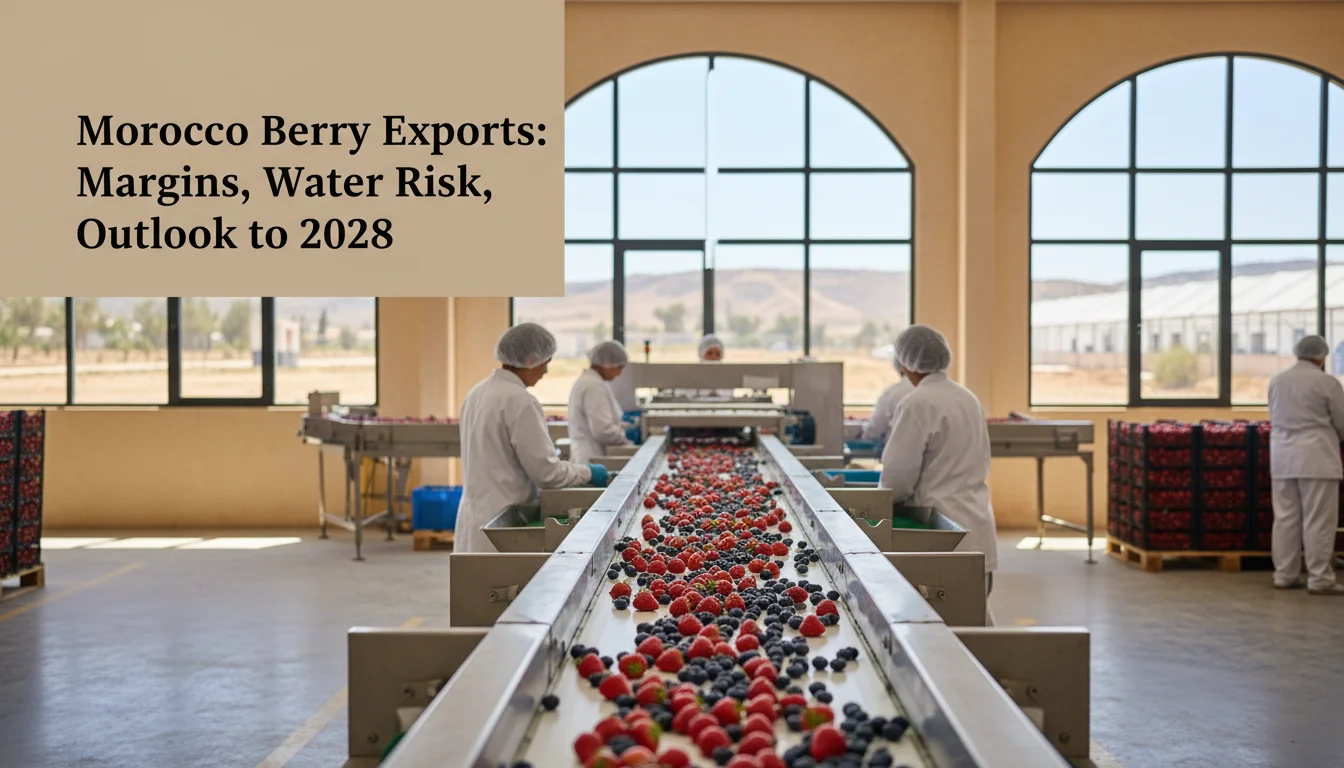
Analysis of Morocco's irrigated berry export sector covering land costs, water risk pricing, margin sustainability, and investment outlook through 2028.
Executive Summary
Morocco has emerged as one of the world's fastest-growing berry exporters, leveraging proximity to European consumers, competitive labor costs, and an expanding irrigated perimeter in the Souss-Massa, Gharb, and Loukkos regions. Blueberries, raspberries, and strawberries now represent a high-value segment within the broader Plan Maroc Vert (Green Morocco Plan) and its successor, Generation Green 2020-2030, which targets doubling agricultural export value. For investors, the opportunity is tangible: Morocco's counter-seasonal production window (October through May) commands premium pricing in EU wholesale markets, and the kingdom's free-trade agreement with the EU eliminates most tariff barriers on fresh berries.
However, the thesis is not without friction. Groundwater tables in key production basins are declining, land acquisition costs near established irrigation infrastructure have risen materially over the past five years, and input-cost inflation (energy, fertilizers, specialized substrates) is compressing farm-gate margins. This article examines the market's size and trajectory, the regulatory incentives available, how Morocco benchmarks against regional competitors, and the risk-adjusted outlook for berry-sector capital deployment through 2028. The analysis is designed for institutional investors, agri-business operators, and advisory teams evaluating entry or expansion in Moroccan irrigated horticulture.
- Morocco's berry exports are estimated at MAD 8-10 billion annually, with blueberries as the fastest-growing sub-segment and compound growth of 15-20% over the past decade.
- Water scarcity in the Souss-Massa basin is the single most material risk; geographic diversification to the Gharb and Loukkos regions is becoming a strategic imperative for new entrants.
- Morocco's cost advantage over Spain (6-8x lower labor costs) and logistical advantage over Egypt (24-48 hour EU transit vs. 3-5 days) underpin its competitive position in the EU berry market.
- Well-managed substrate-based operations can sustain indicative EBITDA margins of 25-35%, but margin bifurcation between modern and legacy operators will accelerate through 2028.
- The regulatory environment is tightening on water extraction while remaining supportive on investment subsidies, creating a premium for operators who secure water rights and invest in efficiency early.
250,000-320,000 tonnes
Projected 2028 export volume
Indicative projection assuming continued acreage expansion, primarily in blueberries and in northern production regions.
Berry Export Market Size and Growth Trajectory
Morocco's fresh berry exports have grown at a compound annual rate estimated in the range of 15 to 20 percent over the past decade, making the kingdom one of the top five suppliers of fresh soft fruit to the European Union. While official consolidated statistics for the berry sub-segment are not always disaggregated from broader fruit and vegetable export data published by the Ministry of Agriculture, industry associations and trade press consistently place Morocco's annual berry export volume in the indicative range of 150,000 to 200,000 tonnes as of the 2023-2024 season. In value terms, this translates to an estimated export revenue of roughly MAD 8 to 10 billion (approximately EUR 750 million to EUR 950 million), though the precise figure fluctuates with seasonal pricing, exchange rates, and the blueberry-to-raspberry mix.
Key growth drivers include:
- Rising EU per-capita consumption of berries, driven by health and convenience trends, with year-round demand increasingly filled by Southern Hemisphere and North African suppliers.
- Expansion of substrate-based (soilless) cultivation, which allows production on marginal land and improves yield consistency.
- Continued investment in cold-chain logistics, including dedicated reefer capacity at the port of Agadir and Tangier Med.
- Varietal innovation, with proprietary genetics from global breeding programs (Driscoll's, Fall Creek, among others) enabling longer harvest windows and improved shelf life.
The Souss-Massa region remains the dominant production zone, accounting for an estimated 60 to 70 percent of national berry output. The Gharb plain and the Loukkos basin in the north are growing in importance, partly because water availability is comparatively less constrained and partly because proximity to Tangier Med reduces transit time to European distribution hubs by roughly one day relative to Agadir.
Looking at the demand side, the EU imported over EUR 4 billion worth of fresh berries in 2023, with Spain, Morocco, and Peru as the three largest external suppliers. Morocco's share of this market has been expanding, supported by logistical advantages (24 to 48 hours door-to-door to major EU retailers) and competitive landed costs. Blueberries have been the fastest-growing sub-category, with Moroccan blueberry acreage reportedly doubling between 2019 and 2023, albeit from a relatively small base.
The following table provides an indicative overview of the trajectory:
| Indicator | 2019 (Est.) | 2023 (Est.) | 2028 (Projected) |
|---|---|---|---|
| Berry export volume (tonnes) | 90,000 - 110,000 | 150,000 - 200,000 | 250,000 - 320,000 |
| Export value (MAD bn) | 4 - 5 | 8 - 10 | 13 - 17 |
| Blueberry share of volume | ~10% | ~20-25% | ~30-35% |
| Primary regions | Souss-Massa | Souss-Massa, Gharb | Souss-Massa, Gharb, Loukkos |
Note: All figures are indicative estimates based on available trade data and industry commentary. They should not be treated as audited statistics.
Regulatory and Incentive Framework
Morocco's agricultural investment environment is shaped by several overlapping policy instruments. The Generation Green 2020-2030 strategy, which succeeded the Plan Maroc Vert, prioritizes value-chain integration, export competitiveness, and water-use efficiency. Berry cultivation, as a high-value irrigated crop, sits squarely within the strategy's target segments.
Investment Charter (2022 reform): Morocco's updated Investment Charter, enacted in late 2022, introduced a tiered incentive system applicable across sectors, including agri-business. Key provisions relevant to berry operations include subsidies covering a portion of tangible investment (land development, cold storage, packing facilities), with enhanced rates for projects located outside the Casablanca-Rabat axis or in provinces designated as priority zones. The charter channels incentive applications through the regional investment centers (Centres Regionaux d'Investissement, or CRIs), which serve as one-stop shops for permits, land allocation, and subsidy disbursement.
Agricultural Development Fund (FDA): The FDA, administered by the Ministry of Agriculture, provides direct subsidies for irrigation equipment (drip systems, reservoirs), greenhouse construction, and cold-chain infrastructure. Subsidy rates have historically ranged from 60 to 100 percent of the cost of drip irrigation equipment, depending on farm size and region. For post-harvest infrastructure such as packing stations and pre-cooling units, the FDA typically covers 20 to 30 percent of eligible investment costs.
Free zones and export facilitation: While most berry farms operate outside formal free-zone perimeters, exporters benefit from Morocco's extensive network of free-trade agreements. The EU-Morocco Association Agreement provides duty-free or preferential access for most fresh fruits and vegetables, subject to entry-price mechanisms for certain products. Berries generally benefit from favorable treatment, particularly outside the EU's own production season. Operators establishing packing or processing facilities may also explore the Tangier Free Zone or Agadir's agro-industrial zones for corporate tax advantages (a standard 0 percent rate for the first five years in designated free zones, followed by a reduced rate).
Water governance: The sector regulator for water resources, the basin agencies (Agences de Bassins Hydrauliques), oversees extraction permits and increasingly enforces volumetric quotas. New borehole permits in the Souss-Massa basin have become significantly harder to obtain, reflecting the government's recognition of aquifer stress. Investors should anticipate that water access will be a binding constraint on expansion and that regulatory enforcement is tightening, not loosening.
Regional Financial Benchmarking: Morocco vs. Peers
To assess Morocco's competitiveness in irrigated berry production, it is useful to benchmark against two relevant peers: Spain (specifically the Huelva region, the EU's largest berry producer) and Egypt (an emerging North African competitor with significant irrigated acreage). The comparison focuses on cost structure, financial incentives, and market access, which are the variables most relevant to capital allocation decisions.
| Factor | Morocco (Souss-Massa) | Spain (Huelva) | Egypt (Delta / New Lands) |
|---|---|---|---|
| Agricultural labor cost (indicative daily rate) | MAD 80-100 (~EUR 7.5-9.5) | EUR 55-70 | EGP 200-300 (~EUR 4-6) |
| Irrigated land cost (lease, per ha/year) | MAD 15,000-40,000 (~EUR 1,400-3,800) | EUR 3,000-6,000 | EGP 30,000-60,000 (~EUR 600-1,200) |
| Water cost / availability risk | Moderate-High (declining aquifers) | Moderate (Donana aquifer stress) | Moderate (Nile allocation politics) |
| Proximity to EU markets | 24-48 hrs by sea/road | Same-day / next-day | 3-5 days by sea |
| EU market access | Preferential (Association Agreement) | Full single market | Preferential (Association Agreement) |
| Corporate tax on agri-exports | 0% (turnover under MAD 5M); reduced rates above | Standard EU rates (~25%) | Exemptions for reclaimed land (time-limited) |
| Government investment subsidies | FDA subsidies (60-100% on drip; 20-30% on infrastructure) | EU CAP / regional funds | Variable; less structured for berries |
Financial implications: Morocco occupies a middle position on labor costs, significantly cheaper than Spain but more expensive than Egypt. However, Morocco's logistical advantage over Egypt is substantial: the 24-to-48-hour transit window to EU retail shelves preserves fruit quality and reduces shrinkage, which directly impacts realized margins. Spanish producers benefit from same-day delivery but face labor costs that are six to eight times higher than Morocco's, making their cost-per-punnet structurally elevated.
On the financial incentive side, Morocco's FDA subsidy regime for irrigation equipment is among the most generous in the Mediterranean basin. Spain's producers access EU Common Agricultural Policy funds, but these are increasingly redirected toward environmental compliance rather than expansion. Egypt offers low land and labor costs but lacks the structured subsidy architecture and the established cold-chain ecosystem that Morocco has built over two decades.
Water risk is the great equalizer. All three origins face tightening water constraints. Spain's Donana aquifer controversy has led to farm closures and regulatory uncertainty. Morocco's Souss-Massa aquifer is under comparable stress. Egypt's water security is tied to Nile allocation dynamics, including the Grand Ethiopian Renaissance Dam. For financial modeling purposes, investors should incorporate a rising real cost of water across all three origins, but Morocco's risk is particularly acute in the Souss-Massa basin, where the majority of current berry acreage is concentrated.
Entry Strategies and Opportunities
Capital deployment in Morocco's berry sector can take several forms, each with distinct risk-return profiles. Smart.by's service lines in Finance, Research, and Strategy are designed to support investors across these entry modes.
1. Greenfield farm development: Acquiring or leasing irrigated land and building a vertically integrated production-packing-export operation. This is the highest-capex route (indicative investment of MAD 800,000 to MAD 1.5 million per hectare for substrate-based blueberry production, including greenhouse, irrigation, and packing infrastructure) but offers the greatest margin capture. The key due diligence requirement is securing a reliable, legally defensible water allocation. Smart.by's Research team can conduct basin-level water-risk assessments and regulatory feasibility studies before capital is committed.
2. Joint ventures with established operators: Partnering with Moroccan farm operators who hold water permits and land but lack expansion capital. This approach de-risks water access and regulatory navigation while allowing the investor to benefit from operational expertise. Smart.by's Strategy practice supports structuring these partnerships, including governance frameworks, profit-sharing mechanisms, and exit provisions.
3. Post-harvest and logistics infrastructure: Investing in packing stations, pre-cooling facilities, or cold-storage capacity near production zones or port gateways. This is a lower-risk, asset-backed play that benefits from the sector's volume growth without direct exposure to agronomic or water risk. Returns are typically more modest but more predictable, resembling infrastructure-like cash flows.
4. Agri-fintech and precision agriculture: Morocco's berry sector is increasingly adopting sensor-based irrigation management, drone-based crop monitoring, and data-driven yield optimization. Smart.by's Innovation service line can help technology providers or venture investors identify partnership opportunities with Moroccan farm operators seeking to improve water-use efficiency and reduce input costs.
Across all entry modes, a rigorous financial model is essential. Smart.by's investment simulator provides a starting framework for scenario analysis, which can be refined through bespoke engagement with our Finance team.
Key Risks and Mitigation
Water scarcity (operational / regulatory): This is the single most material risk. Aquifer depletion in the Souss-Massa region is well documented, and the government has signaled willingness to restrict extraction. Mitigation strategies include diversifying production to the Gharb and Loukkos basins, investing in desalination-fed irrigation (the Chtouka desalination plant is a precedent), and adopting substrate-based cultivation that reduces water consumption per kilogram of fruit by an estimated 30 to 40 percent relative to open-field production.
Market concentration risk: Morocco's berry exports are overwhelmingly directed at the EU, and within the EU, a small number of supermarket chains control purchasing. Any shift in EU phytosanitary standards, maximum residue limits, or trade policy could disrupt access. Mitigation includes diversifying toward the UK (post-Brexit, a separate regulatory regime), the Gulf states, and North American markets, though the latter requires air freight, which compresses margins.
Input-cost inflation: Fertilizers, substrates (coco peat, perlite), and energy costs have risen significantly since 2021. Berry production is input-intensive, and margin compression is a real concern if farmgate prices do not keep pace. Mitigation involves long-term supply contracts, on-farm solar energy generation (Morocco's solar irradiance is among the highest globally), and varietal selection for higher yield per input unit.
Currency risk: Revenue is predominantly in EUR, while a significant portion of costs (labor, land, water fees) is in MAD. The MAD is managed within a basket-linked band, providing relative stability, but any significant appreciation against the EUR would erode export margins. Standard hedging instruments are available through Moroccan banks.
Land tenure and governance: Land acquisition in Morocco can involve complex title histories, particularly for collective (Soulaliyate) lands. Thorough legal due diligence, ideally through local counsel with agricultural transaction experience, is non-negotiable.
Outlook Through 2028
The medium-term outlook for Morocco's berry export sector is constructive but increasingly differentiated by geography and operational model. Three trends will shape the 2025-2028 period:
Geographic rebalancing: The Souss-Massa region will remain the largest production zone, but the marginal hectare of new berry acreage is more likely to be developed in the Gharb or Loukkos basins, where water availability is less constrained and logistics to Tangier Med are favorable. Investors entering the sector now should weight northern regions more heavily in site selection.
Margin bifurcation: Operators with secure water access, modern substrate-based systems, and direct relationships with EU retailers will sustain EBITDA margins in the range of 25 to 35 percent (indicative estimate for well-managed blueberry operations). Operators reliant on open-field production, spot-market sales, and declining aquifer access will face margin erosion and, in some cases, forced exit. This bifurcation creates acquisition opportunities for well-capitalized entrants.
Policy tightening on water: The Moroccan government's National Water Plan and the increasing frequency of drought years make it highly probable that water pricing and extraction quotas will tighten further. Desalination-fed irrigation, while capital-intensive, may become a competitive necessity rather than a luxury. Operators who invest early in water-efficient systems will be better positioned as regulatory constraints bind.
Overall, we expect Morocco's berry export value to grow at a compound annual rate of 10 to 15 percent through 2028, driven by volume expansion (primarily blueberries) and a gradual shift toward higher-value, branded product. The sector's attractiveness to international capital will remain high, but the risk premium associated with water scarcity will rise, favoring disciplined, well-advised investors over speculative entrants.
Conclusion: Positioning for Disciplined Growth
Morocco's irrigated berry sector offers a compelling investment case grounded in structural demand growth, geographic proximity to the EU, and a supportive policy environment. The kingdom's counter-seasonal production window, competitive cost base, and improving logistics infrastructure position it as a durable supplier to European consumers who increasingly expect year-round berry availability.
However, the opportunity is not without complexity. Water scarcity is a binding constraint that will reshape the sector's geography and cost structure over the next five years. Input-cost inflation, market concentration, and regulatory evolution require active management rather than passive exposure. The investors who will generate the strongest risk-adjusted returns are those who combine operational excellence with rigorous due diligence on water rights, site selection, and market diversification.
Smart.by LLC supports investors and operators across the full lifecycle of agri-business investment in Morocco, from initial market research and regulatory mapping through financial structuring and strategic advisory. Whether you are evaluating a greenfield berry farm, a joint venture with an established operator, or a post-harvest infrastructure play, our team provides the data-driven analysis and local market intelligence required to make informed capital allocation decisions.
To discuss your specific investment thesis or request a bespoke sector briefing, contact Smart.by's advisory team.

Les informations fournies par Smart.by sur le site www.smartbyllc.com sont fournies à titre informatif uniquement et ne constituent pas un conseil financier. Veuillez nous contacter pour en savoir plus.
Analyses, actualités et ressources financières
Rejoignez plus de 300 abonnés.


Simplifier les décisions financières complexes grâce à la FAQ.
Un conseil en investissement de bout en bout : allocation de capital, évaluation des risques, fusions-acquisitions et optimisation d'actifs, ainsi qu'un accompagnement dédié aux investisseurs étrangers qui s'implantent au Maroc, incluant l'étude de marché, la navigation réglementaire et la mise en place opérationnelle. Chaque mission s'appuie sur Smart Flow, notre plateforme d'analyse d'investissement en temps réel.
Des investisseurs fortunés, des sociétés de private equity et de capital-risque, ainsi que des entreprises qui se développent au Maroc et en Afrique. Ce qu'ils ont en commun, c'est une préférence pour les données plutôt que pour les suppositions, et pour les résultats plutôt que pour les promesses rassurantes.
Réservez une consultation sur notre site, ou appelez-nous ou écrivez-nous directement. Nous relierons vos objectifs à un plan d'action dès ce premier échange, sans processus d'intégration interminable.
Votre investissement, visible en temps réel. Smart Flow suit l'avancement des projets, fait remonter les risques avant qu'ils ne deviennent un problème, et réunit le reporting financier et la collaboration d'équipe en un seul endroit, afin que vous n'ayez jamais à attendre une mise à jour trimestrielle pour savoir où vous en êtes.
Le tourisme, l'industrie manufacturière, l'agroalimentaire, le transport et la logistique, l'automobile et l'immobilier : des secteurs dans lesquels nous évoluons depuis assez longtemps pour repérer les risques et les opportunités que d'autres manquent.
Un capital déployé de manière délibérée, des risques gérés plutôt que découverts, et une entrée sur le marché qui ne s'enlise pas dans les formalités administratives. Nos clients mesurent le succès en rendements, pas en activité.
Chiffrées, à accès contrôlé, et auditées de manière indépendante et régulière. Vos données d'investissement bénéficient de la même rigueur que votre stratégie d'investissement.
Toujours. Nous gérons l'actif, pas seulement la transaction : suivi continu de la performance, gestion des risques et ajustements stratégiques au fil de l'évolution du marché.
Abonnez-vous à notre newsletter pour recevoir des analyses de marché et de nouvelles opportunités dès qu'elles se présentent, ou suivez-nous sur les réseaux sociaux pour des mises à jour en temps réel.
Elle est intégrée, pas ajoutée après coup. Nous pesons les facteurs environnementaux, sociaux et de gouvernance au même titre que les facteurs financiers, car la valeur à long terme et l'investissement responsable ne s'opposent pas.
Appelez le +212 6 41 52 96 83, ou rendez-nous visite à Tanger, Casablanca ou Marrakech. Vous pouvez également joindre notre équipe à tout moment via la page de contact.

Encore des questions avant de vous engager ?
- Parlez à un consultant, pas à un centre d'appels
- Consultez vos chiffres sur Smart Flow avant de décider