

27
Supplier sites serving the Kenitra vehicle plant
Industry reporting by Automotive Logistics on the build-out of Morocco's automotive supply base around Kenitra.
Operations from 2026, 300+ direct jobs
New Atlantic Free Zone facility
Announced by zone developer MEDZ, indicating continued capacity additions in the zone.
Multi-year full exemption
Corporate income tax on start-up
Industrial Acceleration Zone regime from the start of operations; the post-exemption rate depends on establishment date and the 2023 to 2026 convergence reform.
MAD 35 to 60 million (approx. EUR 3.2 to 5.6 million)
Indicative setup cost, 5,000 m² Tier-2 unit
Illustrative estimate for land, shell, permits, utilities, bonding and certification, excluding production equipment and working capital.
A procedural guide to setting up in the Atlantic Free Zone in Kenitra: the 9 steps from regional investment application to customs-bonded start-up, with indicative costs and timelines.
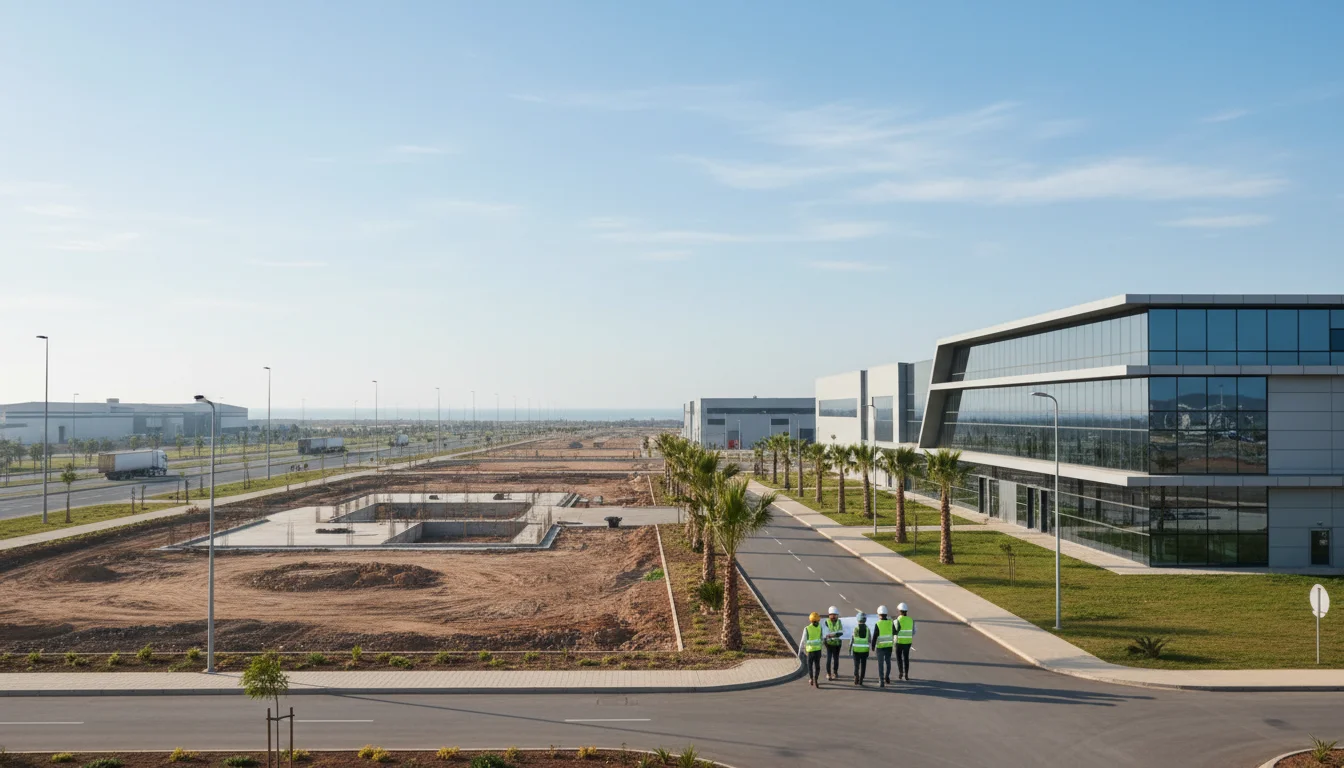
Direct Answer: What This Process Is and Who Needs It
Securing a plot and starting bonded production in the Atlantic Free Zone in Kenitra is a sequenced administrative and real-estate process, not a single application. In practice it runs from a pre-qualification discussion with the zone developer and a file submitted through the regional investment channel, through company incorporation, land allocation, building permit, and finally customs approval of the site so that inputs can enter and finished goods leave under suspension of duties and VAT.
This guide is written for Tier-2 automotive suppliers (wiring components, plastic injection, stamping, sub-assemblies, surface treatment) that have been nominated or short-listed by a Tier-1 or an OEM programme and must now convert that commercial commitment into an operating plant. It is equally relevant to industrial private equity sponsors underwriting such projects and to lenders sizing construction facilities. The zone operates under Morocco's Industrial Acceleration Zone status, which is the legal frame that makes the customs-bonded model possible.
- Setting up in the Atlantic Free Zone in Kenitra is a nine-step sequence running from eligibility screening and the regional investment file through incorporation, land deed, building permit and final customs approval of the site.
- A realistic end-to-end timeline is 14 to 24 months to bonded serial production, with permitting and utility connection usually on the critical path rather than construction.
- Indicative real estate and setup cost for a 5,000 m² Tier-2 unit is MAD 35 million to 60 million (roughly EUR 3.2 million to 5.6 million), excluding production equipment and working capital.
- Industrial acceleration zone status provides a multi-year corporate income tax exemption from the start of operations, but the post-exemption rate depends on establishment date and the 2023 to 2026 convergence reform, so both scenarios must be modelled.
- The recurring compliance exposures are customs inventory reconciliation, activity scope beyond the authorisation, transfer pricing on related-party flows, and build-out milestones written into the land deed.
14 to 24 months
Indicative time to bonded serial production
Illustrative planning range covering the nine-step process, with permitting and utility connection typically on the critical path.
The 9-Step Procedure: From Regional Investment Application to Customs-Bonded Start-Up
The nine steps below reflect the logical sequence most industrial projects follow. Several run in parallel in practice, and the naming of local bodies can vary, so treat institutional references as functional rather than exhaustive.
Step 1. Eligibility and activity screening. Confirm with the zone developer and the applicable sector regulator that your activity qualifies for Industrial Acceleration Zone treatment and that your export orientation matches the zone's mandate. The Kenitra site was conceived as a sector-specific industrial development and hosts established global suppliers such as Lear and Fujikura, which means activity fit is usually assessed against the existing automotive and electronics ecosystem.
Step 2. Technical brief and site sizing. Translate the customer programme into a plot requirement: covered area, yard and truck court, power demand in kVA, compressed air, effluent profile, and expansion option. Under-sizing the plot is the single most common irreversible error.
Step 3. Plot reservation with the zone developer. Obtain a written reservation or option over an identified lot, with price, servicing scope, and build-out deadlines. The zone is developed and managed by MEDZ, which positions the site on the Kenitra to Tangier motorway axis.
Step 4. Investment file through the regional investment channel. Submit the project dossier to the regional investment centre covering Rabat, Sale and Kenitra, which routes it to the competent regional commission for authorisations and, where applicable, for support measures under the national investment framework. This is the step investors usually refer to as the CRI application.
Step 5. Incorporation of the Moroccan operating vehicle. Reserve the corporate name, adopt statutes for an SARL or SA, deposit capital, register with the commercial registry, obtain the tax identifier, and register with the social security body. A one-stop facility on site is designed to compress these formalities.
Step 6. Zone operating authorisation. Secure the authorisation to operate inside the zone perimeter, which fixes the authorised activity, the plot, and the reporting obligations attached to free-zone status.
Step 7. Land deed and building permit. Sign the sale or long-lease deed, then file architectural and technical drawings for the permit, including any required environmental assessment for processes involving chemicals, coatings, or significant effluent.
Step 8. Construction, utilities and equipment import. Build or fit out, connect utilities, and import production equipment under the duty and VAT relief attached to the regime, with each line item traceable to the approved investment programme.
Step 9. Customs approval and bonded start-up. Have the premises accepted by customs as a controlled site, appoint a broker, register in the customs declaration system, demonstrate inventory traceability, then run trial production, customer PPAP validation, and IATF 16949 certification before serial supply.
Indicative Costs and Budget Timeline for a Tier-2 Plant
The figures below are indicative planning ranges for a Tier-2 unit of roughly 5,000 m² covered area on a plot of about 10,000 m², compiled for budgeting discipline rather than as quoted prices. Land pricing, servicing charges and construction rates in the Atlantic Free Zone in Kenitra are negotiated case by case with the developer and move with steel, concrete and labour costs, so every line must be re-priced at term-sheet stage. Conversions use an approximate rate of 1 EUR to 10.8 MAD.
| Budget line | Indicative range (MAD) | Approx. EUR | Indicative duration |
|---|---|---|---|
| Serviced land, purchase basis (per m²) | 900 to 1,600 | 83 to 148 | Reservation to deed: 2 to 4 months |
| Long-lease alternative (per m² per year) | 30 to 70 | 3 to 6 | Same |
| Industrial shell and fit-out (per m² covered) | 3,500 to 6,000 | 324 to 556 | Build: 8 to 12 months |
| Incorporation, legal and notarial | 15,000 to 60,000 | 1,400 to 5,600 | 2 to 5 weeks |
| Permit, technical and environmental studies | 150,000 to 500,000 | 14,000 to 46,000 | 3 to 6 months |
| Utility connections and substation | 300,000 to 1,200,000 | 28,000 to 111,000 | 3 to 8 months |
| Customs bonding setup, broker, traceability system | 200,000 to 600,000 | 19,000 to 56,000 | 4 to 10 weeks |
| IATF 16949 certification and customer PPAP | 400,000 to 900,000 | 37,000 to 83,000 | 4 to 9 months |
On these assumptions, real estate and setup costs excluding production equipment and working capital land in an indicative band of MAD 35 million to 60 million (roughly EUR 3.2 million to 5.6 million). A realistic end-to-end schedule from first site visit to bonded serial production is 14 to 24 months, with permitting and utility connection the usual critical path rather than construction itself.
On the return side, the decisive variable is the tax regime. Companies operating in industrial acceleration zones benefit from a multi-year corporate income tax exemption from the start of operations, followed by a rate that has been reshaped by the 2023 to 2026 convergence reform. Published guidance differs: PwC notes that companies established in these zones before 1 January 2021 retain the earlier regime of a five-year exemption then 8.75% for twenty years, while later entrants are described elsewhere as converging toward the standard rate. Model both scenarios and confirm the applicable rate in writing before committing capital.
Required Documentation Checklist
File quality drives timeline more than any other controllable factor. Assemble the following before approaching the regional investment channel, in French or Arabic with certified translations where originals are in another language.
- Group corporate documents: certificate of incorporation, statutes, ultimate beneficial ownership chart, audited accounts for two to three years
- Board resolution authorising the Moroccan investment and appointing signatories, with legalised powers of attorney
- Investment programme: capital expenditure schedule, equipment list with values and origin, phasing and jobs to be created
- Business plan and financial model with export turnover projections and financing structure (equity, shareholder loan, bank debt)
- Commercial evidence: customer nomination letter, letter of intent or framework supply agreement supporting projected volumes
- Technical dossier: process flow, layout, covered and open area requirements, power and water demand, effluent and waste profile
- Architectural and engineering drawings for the permit, plus environmental assessment where the process requires it
- Plot reservation or option letter from the zone developer, then the signed deed or lease
- Moroccan entity pack: name reservation certificate, statutes, capital deposit certificate, registry extract, tax identifier, social security registration
- Customs pack: operator registration, broker mandate, inventory and traceability procedure, site plan showing controlled areas
- Quality pack: certification roadmap and customer-specific requirements for PPAP submission
Keep a single controlled version register. Divergence between the investment programme filed with the authorities, the equipment list presented to customs, and the fixed-asset ledger is a recurring source of delay and later audit exposure.
Common Pitfalls and Compliance Risks
Treating the tax exemption as unconditional. Free-zone treatment attaches to an authorised activity carried out at an authorised site under customs control. Activities drifting outside the authorisation, such as unapproved domestic sales or trading operations bolted onto a manufacturing licence, can put the regime at risk. Document any local-market sales channel separately and clear it in advance.
Customs inventory discipline. In a bonded plant, duty relief is conditional on reconciling what entered, what was consumed, what was scrapped and what was exported. Weak bills of material, undeclared rework loops and informal scrap disposal create liabilities that surface years later during audit. A Tier-2 supplier with high material turnover needs a system-level reconciliation from day one, not a spreadsheet.
Plot and power under-sizing. Customer volumes ramp. Investors who buy only the footprint required for the first nomination frequently find that expansion land is gone and that the contracted electrical capacity caps the second production line. Secure an expansion option and over-specify the substation.
Permit and study sequencing. Ordering construction before the permit and, where relevant, the environmental clearance is the classic way to lose a quarter. Process families involving coatings, solvents or metal treatment attract heavier scrutiny.
Transfer pricing and related-party flows. A zone entity converting parent-supplied material for group customers sits squarely in transfer pricing territory. Low effective tax at entity level increases, not decreases, the need for defensible documentation.
Labour and ramp-up risk. Skilled operator availability is a genuine strength of the Kenitra ecosystem, supported by on-site automotive training capacity, but recruitment lead times for supervisors, quality engineers and maintenance technicians are routinely underestimated in launch plans.
Deadline covenants in the land deed. Development agreements typically carry build-out and start-of-operation milestones. Missing them can trigger penalties or repurchase clauses, so schedule slippage is a contractual and not merely operational matter.
Where Professional Support Changes the Outcome
Most of the value created or lost in a free-zone project is decided before the first concrete pour, in three places: how the entity is structured, how the plot and the permit are sequenced, and how the customs and tax position is documented.
The first is a structuring exercise. Choice of vehicle, capitalisation, shareholder debt, and repatriation mechanics determine the after-tax return on an asset that will run for fifteen years or more. Smart.by supports this through Financial Advisory and Structuring, including scenario modelling of the exemption period and the post-exemption rate, which is precisely where published guidance diverges and where a wrong assumption distorts an entire investment case.
The second is execution of the administrative path. Sequencing the plot reservation, the investment file, incorporation, the zone authorisation, the permit and the customs approval so they overlap rather than queue is the difference between a 14-month and a 24-month launch. This sits with Market Entry and Business Setup.
The third is the control environment. Bonded manufacturing with related-party flows requires inventory reconciliation, transfer pricing documentation and an audit-ready fixed-asset trail, which is the remit of Risk Management and Compliance.
Upstream of all three, a sponsor deciding between the Atlantic Free Zone in Kenitra and alternative Moroccan or Mediterranean locations needs a comparative read on labour cost, logistics lead time to European assembly plants and supplier depth, which is where Market Research and Intelligence and the investment simulator are typically applied first. The content here is informational and does not constitute financial, tax or legal advice.
Conclusion and Next Steps
For a Tier-2 automotive supplier, the Atlantic Free Zone in Kenitra offers what a green-field location rarely does: an established customer base within short logistics reach, an industrial acceleration regime with a defined tax holiday at the start of operations, and a customs framework built for import-transform-export flows. The ecosystem argument is measurable. Industry reporting has counted 27 supplier sites established to serve the Kenitra vehicle plant, and the zone continues to add capacity, including a facility scheduled to begin operations in 2026 with more than 300 direct jobs.
The risk is not the destination, it is the execution window. Nine administrative steps, a 14 to 24 month realistic schedule, and an indicative MAD 35 million to 60 million of setup cost before production equipment leave little room for sequencing errors or for tax assumptions taken from secondary sources.
The practical next step is a bankable pre-investment file: plot specification, phased capital expenditure, two tax scenarios, and a permitting critical path tied to your customer's start-of-production date. Contact the Smart.by team to scope that file, or review the wider service lines and research resources before committing capital.

Les informations fournies par Smart.by sur le site www.smartbyllc.com sont fournies à titre informatif uniquement et ne constituent pas un conseil financier. Veuillez nous contacter pour en savoir plus.
Analyses, actualités et ressources financières
Rejoignez plus de 300 abonnés.


Simplifier les décisions financières complexes grâce à la FAQ.
Un conseil en investissement de bout en bout : allocation de capital, évaluation des risques, fusions-acquisitions et optimisation d'actifs, ainsi qu'un accompagnement dédié aux investisseurs étrangers qui s'implantent au Maroc, incluant l'étude de marché, la navigation réglementaire et la mise en place opérationnelle. Chaque mission s'appuie sur Smart Flow, notre plateforme d'analyse d'investissement en temps réel.
Des investisseurs fortunés, des sociétés de private equity et de capital-risque, ainsi que des entreprises qui se développent au Maroc et en Afrique. Ce qu'ils ont en commun, c'est une préférence pour les données plutôt que pour les suppositions, et pour les résultats plutôt que pour les promesses rassurantes.
Réservez une consultation sur notre site, ou appelez-nous ou écrivez-nous directement. Nous relierons vos objectifs à un plan d'action dès ce premier échange, sans processus d'intégration interminable.
Votre investissement, visible en temps réel. Smart Flow suit l'avancement des projets, fait remonter les risques avant qu'ils ne deviennent un problème, et réunit le reporting financier et la collaboration d'équipe en un seul endroit, afin que vous n'ayez jamais à attendre une mise à jour trimestrielle pour savoir où vous en êtes.
Le tourisme, l'industrie manufacturière, l'agroalimentaire, le transport et la logistique, l'automobile et l'immobilier : des secteurs dans lesquels nous évoluons depuis assez longtemps pour repérer les risques et les opportunités que d'autres manquent.
Un capital déployé de manière délibérée, des risques gérés plutôt que découverts, et une entrée sur le marché qui ne s'enlise pas dans les formalités administratives. Nos clients mesurent le succès en rendements, pas en activité.
Chiffrées, à accès contrôlé, et auditées de manière indépendante et régulière. Vos données d'investissement bénéficient de la même rigueur que votre stratégie d'investissement.
Toujours. Nous gérons l'actif, pas seulement la transaction : suivi continu de la performance, gestion des risques et ajustements stratégiques au fil de l'évolution du marché.
Abonnez-vous à notre newsletter pour recevoir des analyses de marché et de nouvelles opportunités dès qu'elles se présentent, ou suivez-nous sur les réseaux sociaux pour des mises à jour en temps réel.
Elle est intégrée, pas ajoutée après coup. Nous pesons les facteurs environnementaux, sociaux et de gouvernance au même titre que les facteurs financiers, car la valeur à long terme et l'investissement responsable ne s'opposent pas.
Appelez le +212 6 41 52 96 83, ou rendez-nous visite à Tanger, Casablanca ou Marrakech. Vous pouvez également joindre notre équipe à tout moment via la page de contact.

Encore des questions avant de vous engager ?
- Parlez à un consultant, pas à un centre d'appels
- Consultez vos chiffres sur Smart Flow avant de décider