

20% of annual production
Surplus injection cap
Maximum share of output a self-producer may sell to the grid operator under the Law 82-21 framework.
MAD 0.21/kWh peak, MAD 0.18/kWh off-peak
Surplus tariff (1 Mar 2026 to 28 Feb 2027)
Set by the national electricity regulator for high, extra-high and medium-voltage networks; roughly USD 0.023 per kWh at peak.
6.07 centimes/kWh medium-voltage distribution; 6.81 centimes/kWh system services; 6.85 centimes/kWh transmission
Network usage charges from 1 March 2026
The transmission figure was reported differently by one publication at MAD 0.0638/kWh, so it should be verified against the regulator's decision.
9 June 2026
Entry into force of Decree No. 2-25-100
Published in Official Bulletin No. 7489; the point at which Morocco's self-production regime became operationally executable.
How Morocco's corporate PPA and self-production market works after Law 82-21: wheeling tariffs, the 20% surplus cap, grid-access regimes and where industrial returns sit in 2026.
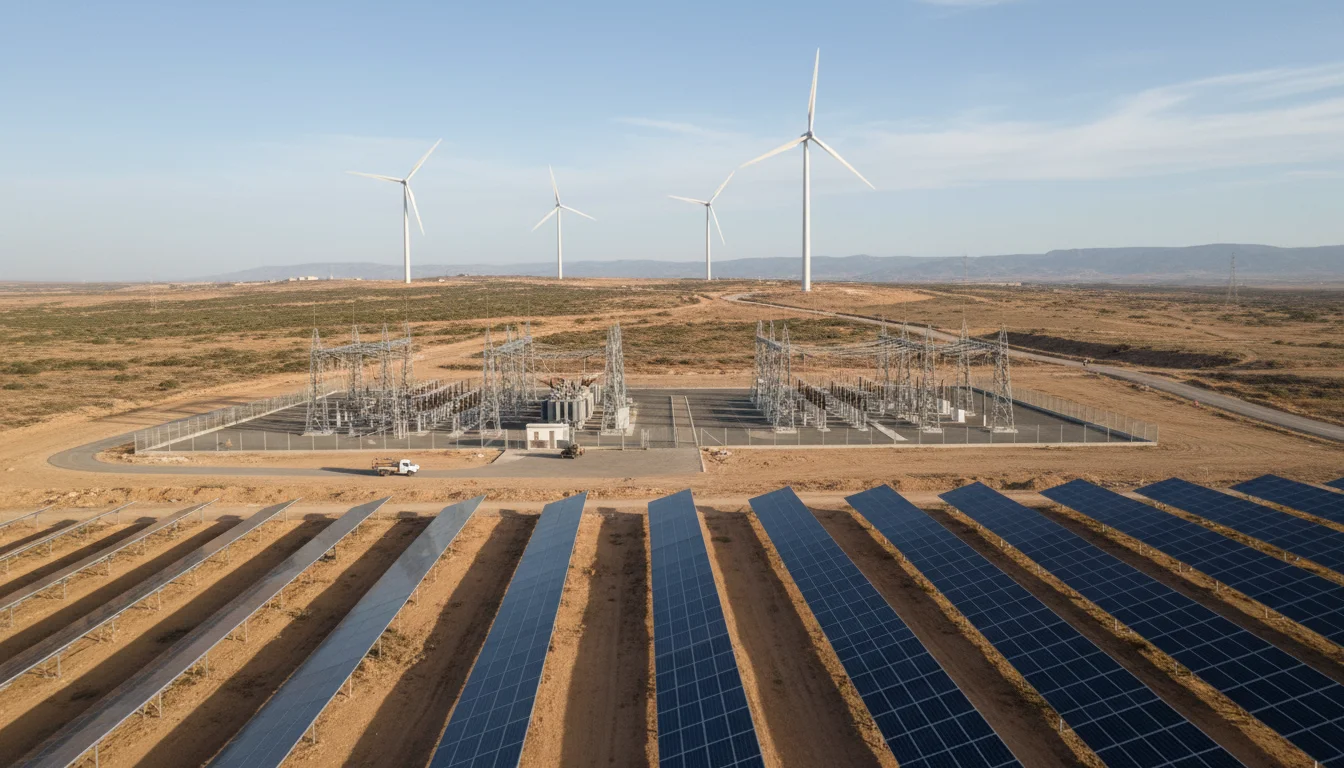
Executive summary: what changed and why 2026 is the decision year
Direct answer: Morocco's corporate PPA and industrial self-production market became operationally executable in 2026. Law 82-21 on self-generation was promulgated in February 2023, but it lacked implementing texts until Decree No. 2-25-100 was adopted and published, appearing in Official Bulletin No. 7489 with entry into force on 9 June 2026. In parallel, the national electricity regulator ANRE fixed the two numbers that actually drive bankability: the price paid for surplus injection and the cost of using the networks. Surplus is remunerated at MAD 0.21 per kWh in peak hours and MAD 0.18 per kWh off-peak (roughly USD 0.023 at peak), for the window 1 March 2026 to 28 February 2027.
For capital allocators, the consequence is specific rather than thematic. The economics of a Moroccan corporate PPA are no longer a function of policy expectation; they are a function of three measurable variables: the delivered cost of generation, the published network usage charges, and the retail tariff the offtaker avoids. Surplus sale remains capped, grid connection volumes are capped, and the tariff period is deliberately short, which means the window for locking in visibility is narrow. Projects structured in the twelve months following June 2026 will be priced against a published, auditable tariff stack. Projects that wait will be priced against ANRE's announced comprehensive review in 2027.
- Morocco's self-production and corporate PPA framework became executable on 9 June 2026, when the implementing decree for Law 82-21 entered into force after publication in Official Bulletin No. 7489.
- Permitting follows three capacity-based regimes: declaration for off-grid or low-voltage units, a connection agreement from 11 kW to 5 MW, and authorisation at 5 MW and above on medium, high or very high voltage.
- Surplus sales are capped at 20% of annual production and remunerated at MAD 0.21 per kWh in peak hours and MAD 0.18 off-peak for the window to 28 February 2027, so project returns must rest on avoided retail cost, not surplus revenue.
- Published network charges of 6.07 centimes per kWh for medium-voltage distribution and 6.81 centimes for system services consume only a modest share of an industrial tariff that plausibly sits between MAD 1.00 and 1.60 per kWh.
- The binding constraint is grid access rather than regulation: connections are capped, and the regulator has announced a comprehensive tariff review in early 2027, making 2026 a window for locking in visibility.
46% of installed capacity in 2025, up from 37% in 2021
Renewables in the electricity mix
Against a target of exceeding 52% by 2030; total installed capacity is about 12 GW, of which roughly 5.6 GW is renewable.
Market size and growth trajectory: sizing the self-production and corporate PPA market
Morocco's power system provides the demand-side logic for the corporate PPA market. Total installed capacity stands at approximately 12 GW, of which renewables account for about 5.6 GW following the addition of more than 1,700 MW. The Minister of Energy Transition has stated that the renewable share of the national electricity mix rose from 37% in 2021 to 46% in 2025, against a target of exceeding 52% by 2030.
A rigorous read requires separating capacity share from generation share, because the two are routinely conflated. On the generation side, Morocco remains fossil-heavy: on 2024 US Energy Information Administration data, electricity came from fossil fuels (75.66%), wind (16.74%), solar (5.69%) and hydro (1.91%). Other trackers place the 2024 renewable generation share closer to 27%, so the honest range for renewable generation is roughly a quarter of output, versus roughly 45% to 46% of installed capacity. That gap, driven by coal baseload and intermittency, is precisely the gap distributed self-production is being asked to help close.
| Indicator | 2021 | 2024 to 2025 | 2030 target |
|---|---|---|---|
| Renewables, share of installed capacity | 37% | 46% (2025) | Above 52% |
| Total installed capacity | Not reported in sources used | Approx. 12 GW, of which 5.6 GW renewable | Not reported in sources used |
| Renewables, share of generation | Not reported in sources used | Approx. 24% to 27% (2024, sources diverge) | Not reported in sources used |
| Surplus injection cap for self-producers | Framework not yet applicable | 20% of annual production | Subject to ANRE review |
The second growth driver is cost. Industrial electricity in Morocco is not cheap by regional standards, and the direction of travel is upward. One market operator reports that the industrial medium-voltage peak-band tariff has risen about 15.7% in five years to 1.57 MAD/kWh in 2026, a single-source figure that should be treated as indicative rather than official. Published tariff grids show medium-voltage industrial consumption closer to MAD 1.00 per kWh and professional low voltage materially higher, so the practical planning range for a C&I offtaker is roughly MAD 1.00 to 1.60 per kWh (approximately EUR 0.09 to 0.15) depending on voltage tier, season and time band. Against that retail benchmark, a corporate PPA or self-production asset competes on avoided cost, not on the MAD 0.18 to 0.21 per kWh surplus price. Grid capital expenditure supports the same thesis: Morocco has signalled investment of more than MAD 27 billion (about USD 2.7 billion) over five years in network and generation projects. Smart.by's view is that the addressable near-term market is concentrated in energy-intensive manufacturing, agro-industry, cold chain, mining and data-adjacent loads with medium-voltage connections and stable daytime profiles.
Regulatory and incentive framework: three regimes, one surplus cap, two tariff decisions
Law 82-21 established, for the first time, a dedicated legal framework for self-generation, enacted alongside the law creating the national electricity regulator. Previously, self-consumption sat in a partial regime in which authorisation applied only below 50 MW or above 300 MW, leaving facilities between 50 MW and 300 MW unregulated.
The architecture now runs on capacity and connection voltage. Legal analysis of the framework sets out three regimes: declaration for off-grid or low-voltage facilities, a connection agreement for facilities between 11 kW and 5 MW on low or medium voltage, and authorisation for facilities of 5 MW or more on medium, high or very high voltage. The same analysis flags the eligibility condition that matters most for third-party-financed corporate PPA structures: the self-generator must own the facility or hold the right to dispose of it, which is why sale with retention of title appears better suited than lease structures, where the lessee holds only a right of use. This is a structuring constraint, not a detail, and it directly affects how an independent sponsor books the asset.
On the incentive side, the practical levers are the published tariff stack and the right to monetise surplus. Self-producers may inject and sell surplus under a clear legal framework for consuming their own solar output, subject to the cap of 20% of annual production sold to the grid operator. Authorisation processes are simplified for smaller low-voltage installations, and grid access conditions, including technical and financial requirements for transporting surplus, are now defined. Additionally, connections are capped to protect the system, which converts grid access into a queue-management exercise rather than an entitlement.
Beyond energy-specific rules, sponsors should assess the general investment framework through the applicable regional investment centre, the sector regulator for grid access decisions, and free zone or industrial acceleration zone status where the offtaker's site qualifies. Smart.by does not treat any of these as automatic: eligibility, cumulation with sector incentives, and the interaction with the carbon tax reported as taking effect in early 2026 all require case-level verification through risk management and compliance review.
Regional benchmarking: the financial case for Morocco versus North African peers
The financial logic of a Moroccan corporate PPA rests on a wide spread between retail tariffs and delivered renewable cost, plus published network charges that make that spread calculable. ANRE has set network usage charges effective 1 March 2026 at, 6.85 centimes per kWh for the national transmission network, 6.07 centimes for the medium-voltage distribution network, and 6.81 centimes for system services compensation. One trade publication reported the medium-voltage network tariff at MAD 0.0607 per kWh and the national transmission tariff at MAD 0.0638 per kWh, a divergence on the transmission figure that sponsors should resolve against the regulator's own decision before financial close. For context, the medium-voltage distribution tariff was first set at 5.92 centimes per kWh for the period from March 2025, as a single national tariff.
On indicative arithmetic, a medium-voltage wheeled structure therefore carries roughly MAD 0.13 per kWh in distribution plus system services charges, rising toward MAD 0.20 per kWh where transmission is also used. Against a planning retail range of MAD 1.00 to 1.60 per kWh, the wheeling stack consumes only a modest share of the avoided cost. That is the single most investable feature of the Moroccan framework in 2026.
| Financial comparator | Morocco | Egypt (indicative) |
|---|---|---|
| Industrial medium-voltage tariff | Approx. MAD 1.00 to 1.60 per kWh (sources diverge by band) | Approx. EGP 0.85 to 1.10 per kWh, described as estimated |
| Published third-party network usage tariff | Yes: 6.07 centimes per kWh medium voltage, 6.81 centimes system services | Not evidenced in the sources used here |
| Surplus remuneration | MAD 0.21 peak, MAD 0.18 off-peak, capped at 20% of annual output | Not evidenced in the sources used here |
| Tariff direction | Upward, with comprehensive ANRE review announced for early 2027 | Upward, driven by subsidy phase-out and currency reform |
Egypt's reported industrial tariffs, cited as estimates in the EGP 0.85 to 1.10 per kWh range for medium voltage, translate into a lower nominal cost base but a thinner self-production arbitrage, alongside currency and subsidy-reform volatility that regional tariff reviews attribute to significant industrial tariff increases since 2020 across markets including Egypt, with further reforms scheduled. Tunisia offers a smaller load base and a shallower industrial offtaker pool; its regime is not covered by the sources used here, so no comparative figures are asserted. The institutional differentiator for Morocco is procedural: a named regulator issuing dated, time-limited tariff decisions, a decree with a defined entry into force, and a capacity-tiered permitting ladder. For sponsors, that converts country risk into schedule risk, which is the easier risk to price. Smart.by addresses this through financial advisory and structuring work that models the wheeling stack and the surplus cap explicitly rather than embedding them in a blended assumption.
Entry strategies and opportunities: how capital can access the window
Four routes dominate in 2026. First, behind-the-meter self-production at the offtaker's site, sized to the daytime load so that injection stays inside the 20% surplus allowance. This is the cleanest path: declaration or connection-agreement regime depending on capacity, no transmission charge, and the full retail tariff avoided. Second, off-site generation wheeled to the consumption point, which triggers grid access negotiation and the published network tariffs, and suits multi-site industrial groups whose rooftops cannot host sufficient capacity. Third, independent power production with bilateral supply, where legal commentary notes that operators must enter a grid access agreement with ONEE, with pricing and technical terms set jointly with the regulator, and that key corporate PPA terms include offtaker creditworthiness, connection voltage and wheeling charges, curtailment and grid capacity risk. Fourth, platform aggregation: acquiring or co-developing a pipeline of 1 MW to 5 MW connection-agreement assets across industrial zones, where permitting is lighter and replication is faster than at authorisation scale.
Each route maps to a distinct advisory need. Site and offtaker screening, load-profile analysis and queue intelligence sit with market research and intelligence. Capital structure, tenor matching against a one-year tariff window, and sensitivity to the 2027 review sit with investment strategy and planning. Vehicle selection, the right-to-dispose condition and title retention mechanics sit with market entry and business setup. Portfolio sponsors building repeatable C&I assets should also consider asset and portfolio management support for performance monitoring and reinvestment sequencing. Investors wanting a first-pass economic read before committing to diligence can start with the investment simulator and review comparable transaction formats under deals and projects. The strategic point is sequencing: secure the offtaker and the connection position first, since tariff parameters are published and therefore not a source of competitive advantage, while grid capacity is capped and therefore is.
Key risks and mitigation
Regulatory and tariff risk. The defining feature of the current framework is its short duration. The surplus tariff runs only to 28 February 2027, and the regulator has signalled a one-year evaluation window before a comprehensive review of the pricing framework in early 2027. Mitigation: build base cases on avoided retail cost rather than surplus revenue, and stress-test network charges upward.
Grid-access and queue risk. Connections are capped to prevent system overload, so a technically sound project can stall on available capacity at a given substation. Mitigation: pre-screen connection headroom before land or equipment commitments, and prefer behind-the-meter sizing where wheeling is not essential.
Structuring risk. The right-to-dispose eligibility condition means conventional leasing may not qualify the user as a self-generator. Mitigation: adopt title-retention or ownership structures validated against Article 2 of Law 82-21 before signing a corporate PPA.
Operational risk. Intermittency without storage exposes industrial users to mismatch between generation and load, and surplus beyond the 20% cap has no contracted route to value. Mitigation: size to the firm daytime load, and evaluate storage on an economic rather than symbolic basis.
Financial and counterparty risk. Returns depend on offtaker credit over a long tenor in a rising-tariff environment, and on the arithmetic of charges that two reputable publications have reported differently. Mitigation: verify every tariff input against the regulator's published decision, and treat all indicative ranges in this note as planning assumptions, not warranted figures.
Outlook 2026 to 2028: from framework to execution
Three developments should be expected over the next two to three years, each traceable to trends already in motion.
First, a tariff reset in 2027. The current surplus and network tariffs were deliberately set for a single year so the regulator could observe market response before harmonising all tariff periods. A revised framework in early 2027, potentially differentiated beyond simple time-of-use, is the central scenario. Sponsors closing in the 2026 window gain visibility; those closing later gain information. Both are defensible, but they are different trades.
Second, extension to low voltage. The regulator has stated that the low-voltage tariff remains to be determined once the regulatory and technical framework is established. Completing that step would widen the self-production market from industrial and commercial sites to SME and residential segments, with implications for installer capacity, distribution channels and aggregation plays.
Third, capacity catching up with policy. With renewables at roughly 46% of installed capacity in 2025 against a target above 52% by 2030, and renewable generation still near a quarter of output, the structural gap persists. Closing it requires network investment, storage and distributed capacity simultaneously, which is consistent with the announced MAD 27 billion (about USD 2.7 billion) programme. One market platform has suggested the renewable share could approach 50% by 2028; Smart.by treats that as an indicative third-party projection rather than a commitment.
The practical implication: the corporate PPA market in Morocco should move from framework validation in 2026 to competitive deal flow by 2027 and 2028, with grid capacity, not regulation, as the binding constraint.
Conclusion and next steps with Smart.by
Morocco has moved from stated ambition to an executable framework. Law 82-21's implementing decree took effect on 9 June 2026, three permitting regimes are defined by capacity and voltage, surplus sales are capped at 20% of annual production and priced at MAD 0.21 per kWh in peak hours and MAD 0.18 off-peak, and network usage charges are published at 6.07 centimes per kWh for medium-voltage distribution plus 6.81 centimes for system services. Set against an industrial retail tariff in the indicative MAD 1.00 to 1.60 per kWh range and rising, the arithmetic of a corporate PPA or self-production asset is favourable and, more importantly, auditable. The open variables are grid capacity, contractual structuring under the right-to-dispose condition, and the regulator's 2027 tariff review.
For investors, the actionable sequence is to confirm connection headroom, lock the offtaker, structure for eligibility, and model the tariff stack line by line rather than as a blended assumption. Smart.by supports each of these steps across its service lines, from market screening and financial structuring to compliance and portfolio oversight, and maintains further sector material in its resources library. To test a specific site, offtaker or portfolio against the current framework, contact the Smart.by research and advisory team. This note is informational and does not constitute financial advice.

La información proporcionada por Smart.by en el sitio www.smartbyllc.com tiene fines exclusivamente informativos y no constituye asesoramiento financiero. Contáctenos para obtener más información.
Análisis, noticias y recursos financieros
Más de 300 suscriptores confían en nosotros.


Simplificando decisiones financieras complejas a través de preguntas frecuentes.
Asesoramiento de inversión integral: asignación de capital, evaluación de riesgos, fusiones y adquisiciones, y optimización de activos, además de apoyo dedicado para inversionistas extranjeros que ingresan a Marruecos, incluyendo estudios de mercado, orientación normativa y puesta en marcha operativa. Cada proyecto se respalda con Smart Flow, nuestra plataforma de análisis de inversión en tiempo real.
Inversionistas de alto patrimonio, firmas de capital privado y de riesgo, y corporaciones que se expanden hacia Marruecos y África. Lo que todos ellos comparten es una preferencia por los datos frente a las conjeturas, y por los resultados frente a las promesas tranquilizadoras.
Reserve una consulta a través de nuestro sitio web, o llámenos o escríbanos directamente. En esa primera conversación, alinearemos sus objetivos con un plan de acción, sin necesidad de un proceso de incorporación prolongado.
Su inversión, visible en tiempo real. Smart Flow hace seguimiento del avance de los proyectos, detecta los riesgos antes de que se conviertan en un problema, y reúne el reporte financiero y la colaboración del equipo en un solo lugar, para que nunca tenga que esperar un informe trimestral para saber cómo van las cosas.
Turismo, manufactura industrial, agroindustria, transporte y logística, automotriz, e inmobiliario: sectores en los que llevamos el tiempo suficiente para detectar los riesgos y las oportunidades que otros pasan por alto.
Un capital invertido de manera deliberada, riesgos gestionados en lugar de descubiertos, y una entrada al mercado que no se estanca en trámites administrativos. Nuestros clientes miden el éxito en rendimientos, no en actividad.
Cifrados, con acceso controlado y auditados de forma independiente y periódica. Sus datos de inversión reciben el mismo rigor que su estrategia de inversión.
Siempre. Gestionamos el activo, no solo la operación: monitoreo continuo del desempeño, gestión de riesgos y ajustes estratégicos a medida que el mercado evoluciona.
Suscríbase a nuestro boletín informativo para recibir análisis de mercado y nuevas oportunidades apenas surjan, o síganos en redes sociales para actualizaciones en tiempo real.
Está integrada, no añadida después. Consideramos los factores ambientales, sociales y de gobernanza junto con los financieros, porque el valor a largo plazo y la inversión responsable no compiten entre sí.
Llame al +212 6 41 52 96 83, o visítenos en Tánger, Casablanca o Marrakech. También puede comunicarse con nuestro equipo en cualquier momento a través de la página de contacto.

¿Aún tiene dudas antes de decidirse?
- Hable con un consultor, no con un centro de llamadas
- Revise sus cifras en Smart Flow antes de decidir