

Down 1.1% year on year
Cement sales, first eight months of 2026
Reported by the Direction des études et des prévisions financières, which treats cement sales as the main barometer of BTP activity.
Down 22%
Gross Treasury issuance, first eight months of 2026
Part of the DEPF's mixed macro reading at end-August 2026, relevant to public infrastructure financing conditions.
Demanded, not enacted
Status of the control-laboratory reform
The national federation of BTP laboratories has called for a regulatory overhaul; no draft text or timetable appears in available reporting.
Fédération nationale des laboratoires de BTP
Sector body driving the reform
Represented publicly by Aziz Fertahi, who has called for laboratory responsibilities to be clarified.
Morocco's BTP laboratories demand a liability overhaul. What the control-laboratory reform means for construction risk pricing, indemnity and 2030 stadium and rail works.
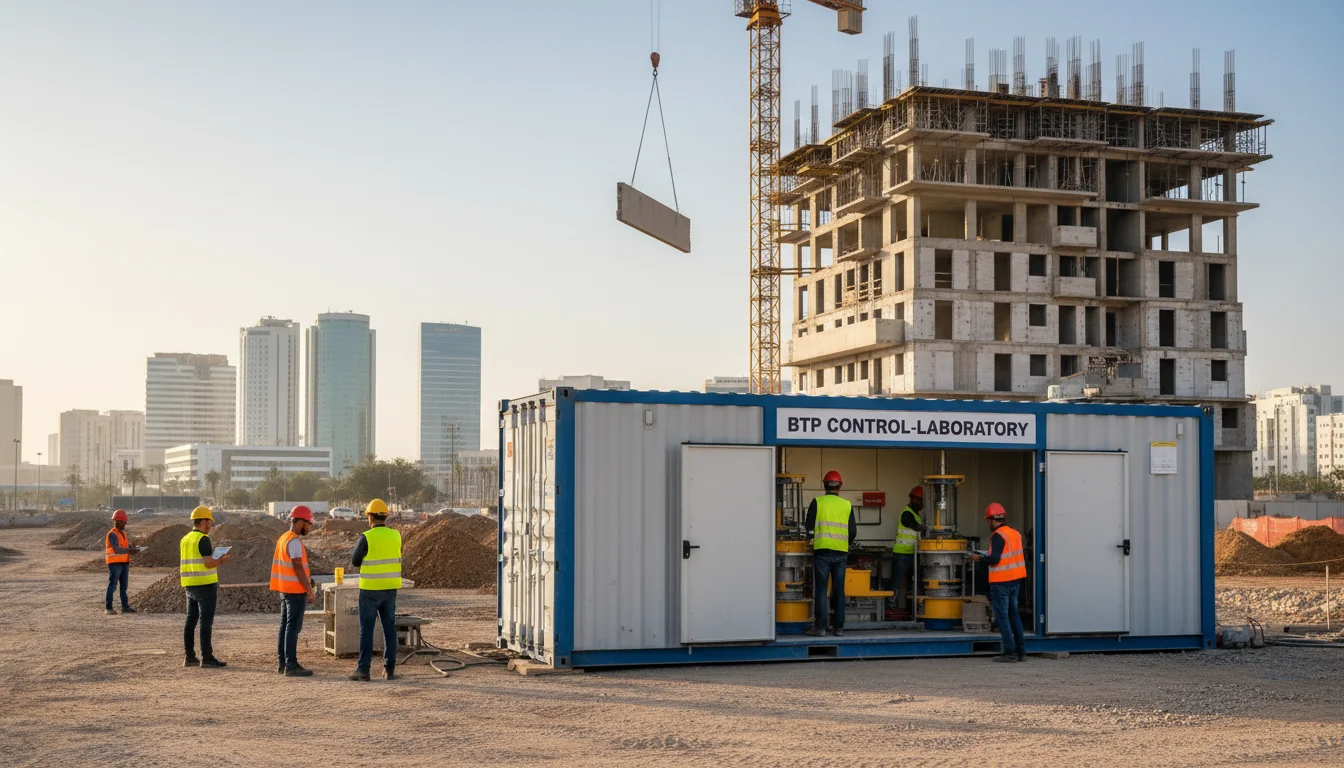
What changed: BTP laboratories are demanding a liability overhaul
In short: Morocco's testing and control laboratories have publicly escalated a long-standing grey zone into a reform demand. According to reporting published five days ago, the Fédération nationale des laboratoires de BTP, through its representative Aziz Fertahi, is calling for the role and responsibilities of construction laboratories to be defined more precisely, citing regulatory vagueness and exposure to litigation. A parallel report notes that, as Morocco accelerates infrastructure delivery, study and control laboratories are warning about grey areas weighing on their activity and are asking for a regulatory overhaul, described in French as a refonte réglementaire.
No draft text, decree number or implementation date appears in the sources reviewed. What has changed is therefore the political and contractual temperature, not yet the law. For anyone pricing construction risk in Morocco, that distinction matters: the BTP control-laboratory reform is currently a signalled reform, and the interim period is where indemnity disputes are most likely to surface.
- Morocco's national federation of BTP laboratories, via Aziz Fertahi, is publicly demanding a regulatory overhaul clarifying laboratory roles, responsibilities and litigation exposure.
- No draft text, decree reference or timetable appears in the available reporting, so the reform is a signalled change rather than an enacted rule.
- Undefined laboratory liability does not vanish; it migrates to contractors and ultimately project owners, making it a construction risk pricing issue, not only a legal one.
- The sector backdrop is tight: DEPF reports cement sales down 1.1% and gross Treasury issuance down 22% over the first eight months of 2026, leaving little room for uninsured quality claims.
- The highest-value actions now are contractual: define mission scope, sampling responsibility, liability caps and verified insurance in laboratory appointments on 2030 stadium and rail packages.
Indicatively under 1%
Testing and control share of hard construction cost
Illustrative estimate used for sensitivity analysis on large civil works, to be verified project by project.
Who it affects: contractors, sponsors, lenders and insurers across the BTP chain
The exposure is not confined to laboratories. Liability allocation in construction is a closed loop: if the technical control link is ill-defined, the residual risk does not disappear, it migrates toward whichever party has the weakest contractual protection, usually the contractor or, ultimately, the project owner.
Directly affected profiles:
- Geotechnical, materials-testing and technical-control laboratories, whose scope of duty and insurance obligations are the direct subject of the reform demand.
- General contractors and civil works subcontractors relying on third-party test results to discharge their own quality obligations.
- Public and parastatal project owners procuring large civil works packages, including those tied to the 2030 football World Cup co-hosting programme and the ongoing high-speed and conventional rail extensions.
- Engineering and design firms whose deliverables depend on soil, concrete and asphalt test data produced by third parties.
- Insurers, reinsurers and brokers underwriting professional indemnity, contractor all-risks and decennial-type covers.
- Lenders and DFIs financing infrastructure on completion-risk and defect-liability assumptions.
Project size drives materiality. On small building works, an ambiguous testing mandate is a commercial nuisance. On stadium, viaduct, tunnel or track-bed works, where a single non-conforming batch can trigger demolition, re-execution and delay claims, the same ambiguity becomes a balance-sheet item. Foreign contractors entering Morocco for 2030-related packages are particularly exposed, because their group indemnity policies are typically written against home-jurisdiction liability concepts that may not map cleanly onto Moroccan practice.
The timing is uncomfortable. The Direction des études et des prévisions financières reports that cement sales, the main barometer of BTP activity, fell 1.1% over the first eight months of 2026, while gross Treasury issuance declined 22% over the same period. A sector with flat volumes and a tighter public financing backdrop has less margin to absorb uninsured quality-related claims, which makes the BTP control-laboratory reform a pricing question rather than a purely legal one.
Detailed provisions and regulation gaps: what a reformed control-laboratory framework must settle
Because no published text is available, the honest analytical approach is to map the gaps the federation has flagged and identify the provisions any credible regulation would have to address. The following is an analytical framework, not a summary of enacted rules.
1. Nature of the obligation. The central question is whether a control laboratory owes a best-efforts obligation on its testing protocol or a results-based obligation on the conformity of the works. Moroccan civil law, in the tradition of the Dahir formant Code des obligations et des contrats, already imposes a long-tail liability regime on builders for structural defects, commonly understood as a ten-year window. Where the laboratory sits inside that chain is precisely the grey zone being contested.
2. Accreditation and scope. A reformed framework would plausibly tie the right to issue control reports to accreditation by the competent national accreditation body and to defined technical scopes, so that a laboratory qualified for materials testing cannot be treated, after the fact, as having assumed a full technical-control or supervision mandate.
3. Mandatory insurance. Clarified liability is only bankable if it is insurable. Any serious regulation should specify minimum professional indemnity cover, aggregate limits and the duration of run-off cover after project acceptance.
4. Sampling chain and evidentiary value. Disputes rarely turn on the test itself but on who took the sample, under what conditions, and whether the report was issued on an adequate sampling plan. Traceability rules, retention periods and the evidentiary weight of a laboratory report in litigation are natural candidates for codification.
5. Procurement and pricing discipline. Where control services are awarded primarily on lowest price, fee compression tends to reduce testing frequency. Qualification-weighted award criteria in public tenders would be the corollary of stricter liability.
| Issue | Current grey zone flagged by the sector | What a reformed regulation could specify |
|---|---|---|
| Scope of duty | Testing versus technical control treated interchangeably | Named mission categories with defined deliverables |
| Liability standard | Unclear whether best-efforts or results-based | Explicit standard per mission category |
| Insurance | Cover levels set by contract, not by rule | Minimum indemnity limits and run-off duration |
| Chain of recourse | Contractor and owner absorb residual exposure | Ordered recourse between owner, contractor, designer and laboratory |
| Public tenders | Price-driven award of control services | Accreditation and capacity weighting |
Two points of caution. First, a reform that raises laboratory liability without raising insurable capacity will simply raise control fees, an effect we would indicatively size in the low single digits of a testing budget that itself typically represents well under 1% of hard construction cost on large civil works. That estimate is illustrative and should be verified project by project. Second, transitional provisions matter more than the substance for contracts already signed on 2030-related packages.
Action steps and next steps for investors, contractors and lenders
The window between a signalled reform and an enacted text is the cheapest moment to restructure contractual protection. Practical priorities:
- Re-read the indemnity clauses you already signed. Identify every contract where a third-party laboratory report is a condition of payment, acceptance or handover, and confirm whether the laboratory carries any back-to-back liability or whether the contractor absorbs it alone.
- Contract around the gap now. Where the regulation is silent, specify the mission category, sampling responsibility, report turnaround, liability caps and insurance evidence directly in the laboratory appointment rather than relying on custom.
- Verify insurance, not just certificates. Request policy wordings, aggregate limits, exclusions for design and supervision, and confirmation of run-off cover extending through the defect-liability period.
- Build a reform-sensitivity case in the financial model. Test the effect of higher control fees, more frequent testing and potential re-execution provisions on contingency and IRR, rather than treating quality control as a fixed line item.
- Escalate testing governance on 2030-linked works. Stadium, track-bed and structural packages justify independent counter-testing and a documented chain of custody, given the compressed programme.
- Monitor the legislative pipeline. Track the federation's position, ministerial responses and any published draft, and diarise a contractual review trigger for the moment a text is circulated.
For groups entering the market, the sequencing question is whether to bid on 2030-related packages before the framework is settled. That is a risk-appetite decision, and it should be taken with an explicit view on indemnity and insurability. Smart.by's Risk Management & Compliance and Financial Advisory & Structuring teams work on exactly this intersection, and our Market Research & Intelligence desk tracks the regulatory pipeline for BTP counterparties.
Conclusion: price the ambiguity, then reprice when the text lands
The BTP control-laboratory reform is, for now, a demand rather than a rule. That is precisely why it is actionable. Liability that is not clearly allocated by regulation is allocated by contract, and in Morocco's current infrastructure cycle the parties drafting the sharpest contracts will be the ones who avoid funding someone else's quality failure. With cement volumes slightly down and public financing conditions tighter, according to the latest DEPF reading, there is limited headroom for unpriced claims on 2030 stadium and rail works.
Our recommendation is straightforward: treat the reform as a scheduled repricing event, document the testing chain now, and revisit indemnity structures the moment a draft text is published. If you are structuring, bidding or lending into Moroccan BTP, contact the Smart.by research desk for a contract-level review, or model a project scenario using our investment simulator. Further sector notes are available in our Resources library. This note is informational and does not constitute financial or legal advice.

La información proporcionada por Smart.by en el sitio www.smartbyllc.com tiene fines exclusivamente informativos y no constituye asesoramiento financiero. Contáctenos para obtener más información.
Análisis, noticias y recursos financieros
Más de 300 suscriptores confían en nosotros.


Simplificando decisiones financieras complejas a través de preguntas frecuentes.
Asesoramiento de inversión integral: asignación de capital, evaluación de riesgos, fusiones y adquisiciones, y optimización de activos, además de apoyo dedicado para inversionistas extranjeros que ingresan a Marruecos, incluyendo estudios de mercado, orientación normativa y puesta en marcha operativa. Cada proyecto se respalda con Smart Flow, nuestra plataforma de análisis de inversión en tiempo real.
Inversionistas de alto patrimonio, firmas de capital privado y de riesgo, y corporaciones que se expanden hacia Marruecos y África. Lo que todos ellos comparten es una preferencia por los datos frente a las conjeturas, y por los resultados frente a las promesas tranquilizadoras.
Reserve una consulta a través de nuestro sitio web, o llámenos o escríbanos directamente. En esa primera conversación, alinearemos sus objetivos con un plan de acción, sin necesidad de un proceso de incorporación prolongado.
Su inversión, visible en tiempo real. Smart Flow hace seguimiento del avance de los proyectos, detecta los riesgos antes de que se conviertan en un problema, y reúne el reporte financiero y la colaboración del equipo en un solo lugar, para que nunca tenga que esperar un informe trimestral para saber cómo van las cosas.
Turismo, manufactura industrial, agroindustria, transporte y logística, automotriz, e inmobiliario: sectores en los que llevamos el tiempo suficiente para detectar los riesgos y las oportunidades que otros pasan por alto.
Un capital invertido de manera deliberada, riesgos gestionados en lugar de descubiertos, y una entrada al mercado que no se estanca en trámites administrativos. Nuestros clientes miden el éxito en rendimientos, no en actividad.
Cifrados, con acceso controlado y auditados de forma independiente y periódica. Sus datos de inversión reciben el mismo rigor que su estrategia de inversión.
Siempre. Gestionamos el activo, no solo la operación: monitoreo continuo del desempeño, gestión de riesgos y ajustes estratégicos a medida que el mercado evoluciona.
Suscríbase a nuestro boletín informativo para recibir análisis de mercado y nuevas oportunidades apenas surjan, o síganos en redes sociales para actualizaciones en tiempo real.
Está integrada, no añadida después. Consideramos los factores ambientales, sociales y de gobernanza junto con los financieros, porque el valor a largo plazo y la inversión responsable no compiten entre sí.
Llame al +212 6 41 52 96 83, o visítenos en Tánger, Casablanca o Marrakech. También puede comunicarse con nuestro equipo en cualquier momento a través de la página de contacto.

¿Aún tiene dudas antes de decidirse?
- Hable con un consultor, no con un centro de llamadas
- Revise sus cifras en Smart Flow antes de decidir