
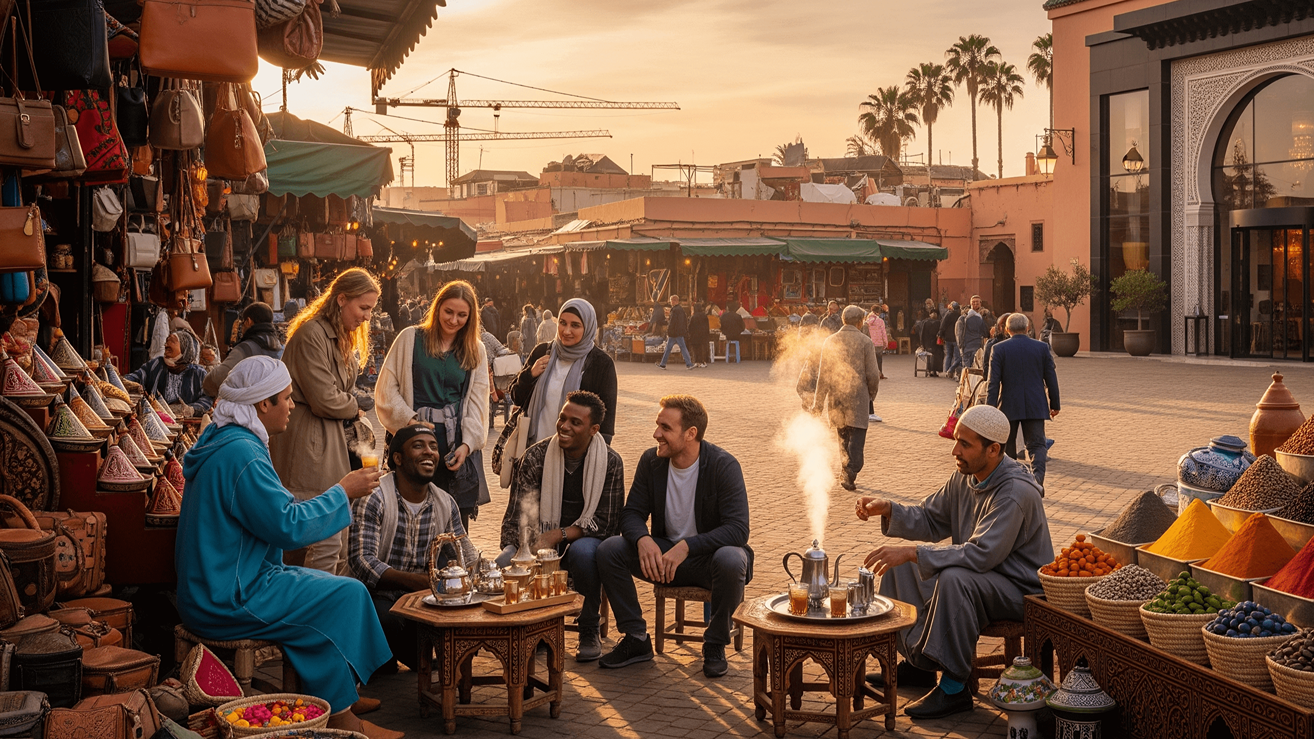
Morocco's tourism sector has evolved from a regional curiosity into one of Africa's most strategically significant investment destinations. In 2024, tourism contributed 11.7% of national GDP and generated over 120 billion MAD in receipts. Passenger traffic at Moroccan airports and seaports surged 16.4% year-on-year in Q1 2025, reflecting sustained structural demand growth rather than post-pandemic rebound alone. The government's national tourism strategy targets 26 million annual visitors by 2030, backed by substantial public infrastructure investment, aviation liberalization, and a regulatory framework designed to attract and protect foreign capital.
For international investors, Morocco's tourism sector presents opportunities across multiple asset classes and development stages. The market is large enough to absorb significant capital and early enough in its maturity cycle to reward well-positioned entrants with above-average returns. This guide examines the regional investment landscape, key segments, regulatory incentives, and strategic considerations relevant to foreign capital deployment in Moroccan tourism.
Regional Investment LandscapeMorocco's tourism geography is highly varied. Each region presents a distinct demand profile, infrastructure maturity, and competitive environment. Capital allocation decisions should be grounded in regional specificity rather than national headline figures.
Marrakech and the Atlas Mountain CorridorMarrakech is Morocco's most internationally recognized tourism destination, attracting over 4 million visitors annually and generating the highest hotel RevPAR in the country. The UNESCO-listed medina, world-class dining, and proximity to the Atlas Mountains sustain layered demand across luxury, cultural, and adventure segments year-round. The Atlas corridor extending from Ouarzazate to Imlil has seen growing investment interest in boutique eco-lodges, glamping developments, and trekking infrastructure as international traveler profiles shift toward experiential and off-the-beaten-path offerings.
- Investment focus: Luxury riad restoration, boutique hotels, eco-lodges, adventure infrastructure
- Key advantage: Direct air access to 60+ European and Middle Eastern cities via Marrakech-Ménara Airport
- Consideration: Architectural integration requirements apply for medina-adjacent developments
Agadir is Morocco's most developed mass-market coastal resort destination with established hotel infrastructure, a modernized seafront, and consistent year-round demand from Northern European leisure travelers. Beyond Agadir, the broader Atlantic coastline offers compelling development opportunities at earlier stages of the tourism cycle. Dakhla has emerged as a world-class destination for kitesurfing and wind sports, attracting a high-spending international demographic that supports premium lodge and glamping investments. Essaouira's Atlantic character and UNESCO medina provide a differentiated product for cultural and wellness tourism.
- Investment focus: Hotel repositioning, resort development, golf infrastructure, boutique coastal lodges
- Key advantage: Year-round demand, established charter and scheduled air connectivity from Europe
- Consideration: Primary market is maturing — differentiation is essential for above-average returns
Tangier has undergone a fundamental transformation over the past decade driven by the Tanger Med Port complex, the high-speed rail connection to Casablanca, and significant urban redevelopment. Its position at the intersection of Europe and Africa, combined with its cosmopolitan heritage, positions it as a growing destination for business tourism and short-break leisure travel from Spain and Portugal. The M'diq-Fnideq coastal corridor to the east offers beach resort development opportunities supported by government investment grants of up to 250 MAD per square meter of built tourism infrastructure.
- Investment focus: Business hotels, boutique city hotels, coastal resort development
- Key advantage: 35 minutes from Spain by ferry, direct TGV to Casablanca, growing MICE demand
- Consideration: Earlier stage market — higher upside but requires longer investment horizon
Fès is Morocco's cultural capital, home to the world's oldest university and one of the best-preserved medieval urban environments on earth. Tourism investment centers on riad restoration and boutique hospitality within the UNESCO-listed medina, experiential cultural programming, and artisanal industry integration. The city attracts a higher-spending, longer-stay visitor profile than beach resorts, with growing demand from American and Asian markets seeking authentic cultural immersion. Heritage tourism investments benefit from dedicated restoration grant programs administered by municipal and regional authorities.
- Investment focus: Riad restoration, boutique heritage hotels, cultural experience operators
- Key advantage: Higher average spend per visitor, growing North American and Asian demand
- Consideration: Operational complexity of heritage properties requires specialized management expertise
The Drâa-Tafilalet region encompassing Merzouga, Zagora, and the Draa Valley represents one of Morocco's fastest-growing tourism frontiers. International visitors pay premium rates for curated desert experiences including luxury camps, camel trekking circuits, and 4x4 adventure routes. Infrastructure constraints including road connectivity and utilities provision represent both a challenge and an investment opportunity, with the government prioritizing infrastructure spending in this region as part of its tourism diversification strategy. Early movers in well-positioned desert hospitality assets have captured significant pricing power.
- Investment focus: Luxury desert camps, eco-lodges, adventure tourism operators
- Key advantage: Premium pricing, limited supply, strong international media coverage
- Consideration: Infrastructure constraints require careful due diligence on utilities and access
Morocco's hotel sector remains structurally undersupplied relative to government visitor targets, particularly in the four- and five-star categories in secondary cities and emerging destinations. International brands including Accor, Marriott, and Hilton have established significant presences in primary markets, creating management contract and franchise opportunities for real estate developers seeking branded exposure without operational complexity. The government's tourism investment framework provides specific incentives including reduced corporate tax rates capped at 20% for hotel operators (versus the standard 31%), VAT exemptions on qualifying construction materials, and investment grants for developments meeting architectural, environmental, and employment standards.
Eco-Tourism and Sustainable TravelMorocco's natural heritage — Mediterranean coastline, Atlantic beaches, Atlas Mountain ecosystems, and Saharan landscapes — provides a diverse platform for sustainable tourism development. International demand for authentic, low-impact travel experiences has created premium pricing opportunities for well-positioned eco-lodges, nature reserves, and conservation-linked hospitality assets. The government's alignment of tourism strategy with its broader climate commitments creates favorable conditions for green-certified projects that can access both tourism incentives and renewable energy frameworks.
Adventure and Experiential TourismMorocco's geography supports a comprehensive adventure tourism ecosystem: trekking in the High Atlas, rock climbing in Todra Gorge, surfing from Taghazout to Dakhla, desert expeditions, and cycling routes through the Middle Atlas. Investment opportunities exist across activity operators, equipment rental facilities, guide training programs, and destination infrastructure. These assets typically require lower capital outlay than full hospitality developments while generating stable recurring revenues from a growing international adventure traveler segment that skews younger and higher-spending than traditional leisure tourists.
Tourism Technology and Digital ServicesMorocco's tourism sector is increasingly receptive to technology investment across booking platforms, experience aggregators, destination management systems, and data analytics tools. The Digital Morocco 2025 strategy and the concentration of digital talent in Casablanca and Rabat create a favorable environment for technology-enabled tourism businesses. This segment offers lower capital entry requirements and faster scaling potential compared to physical infrastructure investments.
Regulatory Environment and Investment IncentivesMorocco's legal framework for tourism investment is designed to facilitate foreign capital deployment at all scales. Foreign investors may establish wholly-owned entities without sector-specific ownership restrictions. The limited liability company (SARL) structure, available with minimum capital of 10,000 MAD, is the most flexible entry vehicle for smaller-scale operations. Public limited companies (SA) require 300,000 MAD for private structures and 3 million MAD for public offerings.
The tourism investment incentive framework includes several mechanisms of direct financial significance:
- Investment grants of up to 250 MAD per square meter of built ground area for qualifying tourism developments in designated coastal corridors and priority destination zones
- Corporate tax advantages with rates capped at 20% on profits above 1 million MAD for hotel operators, compared to the standard 31% rate
- VAT exemptions on tourism services provided to non-resident visitors and on qualifying construction materials for eligible projects
- Tax holidays ranging from 5 to 20 years for investments in Industrial Acceleration Zones and special economic zone frameworks
- Unrestricted capital repatriation for investments financed through foreign currency, processed through commercial banks within 48-72 hours once applicable taxes are satisfied
Real estate acquisition for tourism development follows standard Moroccan property rights frameworks. Foreign investors are entitled to freehold title on urban properties, with transaction costs predictable at 4-8.5% of transaction value inclusive of transfer taxes, registration fees, and notarial charges.
Risk ConsiderationsTourism investment in Morocco carries specific risk factors that require rigorous assessment alongside the opportunity analysis. Seasonal demand concentration in coastal and cultural destinations creates cash flow management requirements that differ from year-round demand markets. Currency risk is limited by Morocco's convertibility regime, which guarantees unrestricted repatriation of investment returns, though dirham exchange rate movements against investor home currencies warrant consideration in financial modeling.
Regulatory execution risk, particularly around incentive program eligibility and grant disbursement timelines, requires experienced local advisory support. Infrastructure quality varies significantly between primary and emerging tourism destinations, with road connectivity, utilities reliability, and healthcare access representing practical considerations for development decisions in secondary locations. Competitive dynamics in primary markets are intensifying as international hotel brands expand, creating margin pressure for undifferentiated products while simultaneously increasing the premium commanded by well-positioned boutique and experiential assets.
Strategic RecommendationsInvestors approaching Morocco's tourism sector should prioritize destination selection based on demand maturity, competitive positioning, and infrastructure quality rather than headline visitor numbers alone. Emerging destinations at earlier stages of the tourism cycle — Dakhla, the M'diq-Fnideq corridor, secondary Atlas valleys — offer more favorable land acquisition costs and less competitive markets than primary destinations, at the cost of lower near-term demand certainty.
Partnership structures with established Moroccan hospitality operators reduce execution risk for investors unfamiliar with Morocco's specific operating environment, providing access to local market intelligence, regulatory relationships, and operational expertise. Management contracts with international hotel brands provide distribution access and brand recognition while limiting direct operational exposure. Incentive optimization requires proactive engagement with regional investment centers from the earliest stages of project development — grant eligibility criteria are best addressed during design phases rather than retrospectively.
Working with Smart.by LLCSmart.by LLC provides comprehensive advisory services for international investors entering Morocco's tourism sector. Our integrated approach covers market research and opportunity identification, financial modeling and investment structuring, regulatory navigation and incentive optimization, and ongoing transaction and asset management support across the full investment lifecycle. With a decade of on-ground experience in Morocco's investment landscape and a track record spanning tourism, hospitality, and real estate transactions, our team provides the local intelligence and international standards that sophisticated investors require to deploy capital effectively in this market.
References- Passenger Numbers Surge 16.4% at Moroccan Airports in Early 2025 — Hespress
- Morocco Tourism Industry Generated 11.7% of the Country's GDP in 2024 — Morocco World News
- Morocco Offers Tax Incentives for Real Estate Investments in Tourism Projects — Morocco World News
- Government Mobilized Under the King to Implement Territorial Development Strategies — Hespress