

19,576 quintals (about 1,958 t)
Legal dry cannabis output, 2025
Up from 18,810 quintals in 2024, per ANRAC, which has also described 2025 output as close to 2,000 tons.
5,765 (4,147 newly issued)
Active ANRAC licences, 2025 season
5,492 cultivation licences for 5,318 farmers; 273 licences for processing, marketing, export, seed import and transport across 183 operators.
3,141 hectares
Licensed harvested area, 2025
2,622 ha of the local Beldia variety and 519 ha of imported varieties, farmed by 4,776 growers.
560 tons across five plants
Processing capacity commissioned in 2025
A further 11 plants were reported under construction, indicating the conversion bottleneck is being addressed.
Analysis of Morocco legal cannabis: ANRAC licensing data, 2025 output of 19,576 quintals, processing bottlenecks, offtake terms and export routes to 2029.
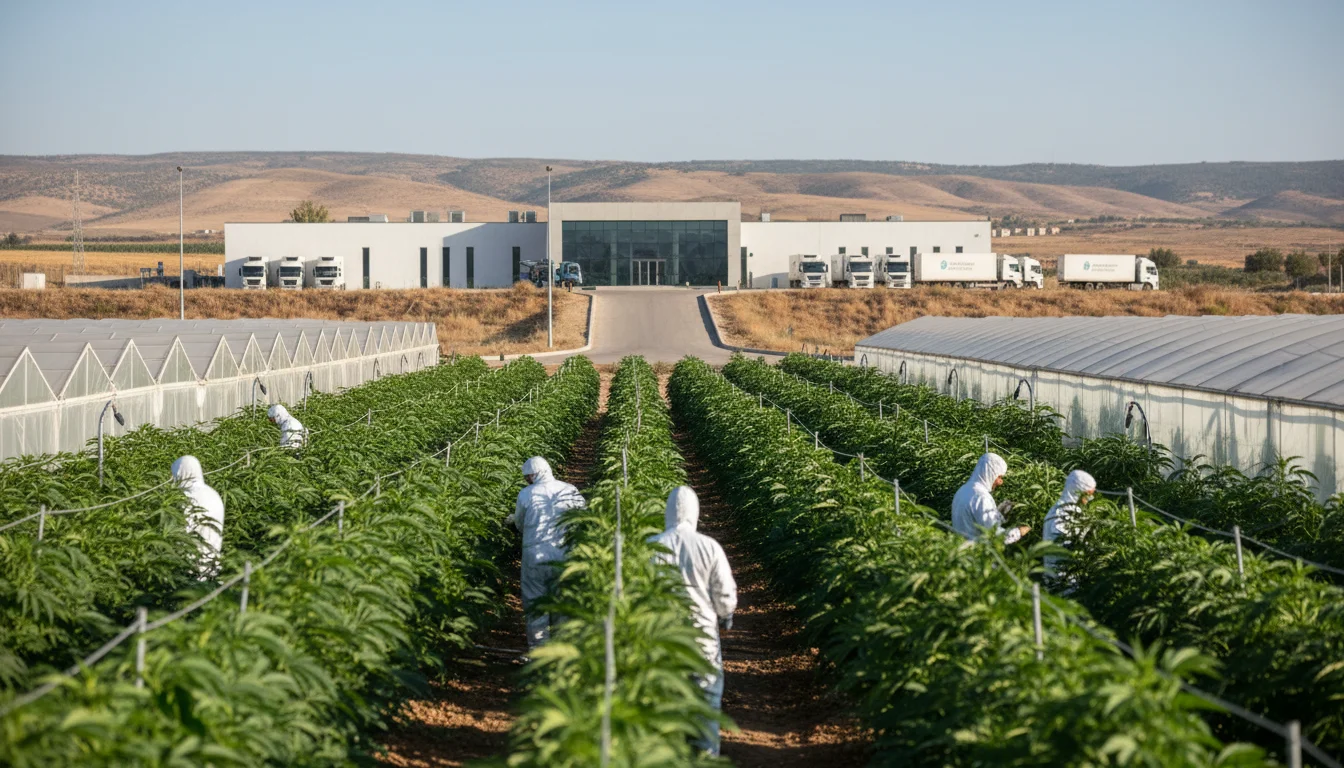
Executive summary: where the value sits in Morocco's legal cannabis chain
Direct answer: the investable opportunity in Morocco's legal cannabis value chain in 2026 is not primary cultivation, which is already crowded and licence-constrained, but the mid-chain: licensed processing and extraction capacity, product registration for regulated consumer and pharmaceutical categories, traceability systems, and export execution into a small but widening set of destination markets. Upstream supply is scaling faster than conversion capacity, and that gap is where pricing power and contractual leverage currently accumulate.
The regulator's own data frames the opportunity. Total dry cannabis production reached 19,576 quintals in 2025, up from 18,810 quintals in 2024, across 3,141 hectares farmed by 4,776 licensed growers, while 4,147 new licences in 2025 took the operational total to 5,765, of which 5,492 cover cultivation and only 273 cover processing, marketing, export, seed import and transport across 183 operators. In other words, roughly 99% of licences sit upstream.
Meanwhile five operators commissioned processing plants in 2025 with a combined stated capacity of 560 tons, with 11 more under construction. For investors and advisers, the strategic question to 2029 is therefore narrow and answerable: who converts the biomass, under what offtake terms, against which registered product dossiers, and through which export corridor.
- Roughly 99% of Morocco's 5,765 active cannabis licences for the 2025 season cover cultivation, leaving only 273 authorisations across processing, marketing, export, seed import and transport for 183 operators.
- Legal dry output reached 19,576 quintals in 2025 versus 18,810 in 2024, growth of about 4% by that measure, while installed processing capacity added in 2025 was 560 tons across five plants with 11 more under construction.
- Value is concentrating downstream: 141 cannabis-based products are registered with the medicines agency, dominated by supplements and cosmetics, with only one registered medicine to date.
- Export reach covers seven markets including France, Switzerland, the Czech Republic, Luxembourg, Portugal, Australia and South Africa, but official revenue figures by product category have not been published.
- Compliance risk is live: 7,526 conformity checks in 2025 led to 111 licence withdrawals, and 1,490 authorisations were withdrawn during the 2026 season, mostly from cultivators.
141 total, 110 added in 2025
Registered cannabis-based products
2025 additions comprised 50 dietary supplements, 59 cosmetics and one medicine, distributed through more than 600 authorised points of sale.
USD 430m to 645m by 2028
Indicative export revenue projection
Third-party industry commentary, not an official figure; treat as an illustrative estimate requiring stress-testing.
Market size and growth trajectory: licensed hectares, output and registered products
Morocco's legal cannabis market is best measured in three stacked layers: licensed agricultural output, installed conversion capacity, and registered end products. Each layer is growing at a different speed, and the mismatch between them is the central commercial fact of the sector.
On output, growth has moved from explosive to incremental. ANRAC reports close to 2,000 tons of dried cannabis in 2025, about 10% above the prior year, consistent with the quintal figures cited by the regulator. Note that public reporting uses more than one measurement basis: some outlets have cited materially larger tonnages for 2024, including more than 4,000 tonnes produced for legal purposes on over 2,700 hectares. Investors should reconcile dry-matter versus green-biomass bases before building any yield model.
| Indicator | 2023 | 2024 | 2025 |
|---|---|---|---|
| Legal dry output | 296 tonnes (first legal harvest) | 18,810 quintals (about 1,881 t) | 19,576 quintals (about 1,958 t) |
| Licensed harvested area | Under 300 ha | Around 2,700 ha | 3,141 ha (2,622 ha Beldia, 519 ha imported varieties) |
| Authorisations issued in year | 721 | 3,029 (as reported mid-2024) | 4,147 (5,765 active in total) |
| Cannabis-based products registered with the medicines agency | Not applicable | 31 (implied cumulative) | 141 cumulative, 110 added in year |
The 2023 baseline of 296 tonnes in the first legal harvest and the licence progression from 721 licences in 2023 to 3,029 in 2024 show how quickly the upstream base was assembled. The downstream layer is the one that now determines revenue. A total of 110 cannabis-based products were registered in 2025 with the Moroccan Agency for Medicines and Health Products, comprising 50 dietary supplements, 59 cosmetics and one medicine, taking the market total to 141, and those products are distributed through more than 600 authorised points of sale.
The product mix matters more than headline tonnage. With cosmetics and supplements dominating registrations and a single registered medicine, near-term revenue in the Morocco legal cannabis market is weighted toward consumer-health categories with faster registration cycles and lower capital intensity, while pharmaceutical-grade value, which carries the higher realisable margin, remains an aspiration rather than a demonstrated earnings stream. On external demand, Moroccan products have established a presence in seven countries: France, Switzerland, the Czech Republic, Luxembourg, Portugal, Australia and South Africa. Published export earnings by category are not available; sector analysis notes that the cited figures do not establish sales by product category or export revenue. Any market size stated in value terms today should therefore be treated as an indicative estimate, not a verified figure.
Regulatory and incentive framework: Law 13-21, ANRAC licensing and investment support
The legal architecture is unusually centralised for an agri-business sector, which simplifies diligence but concentrates regulatory risk. Law 13-21, adopted in 2021, established the regulated framework for medical, pharmaceutical and industrial cannabis, and ANRAC oversees cultivation in designated areas of Al Hoceima, Chefchaouen and Taounate, where approved cooperatives supply licensed buyers under contract. Recreational use remains prohibited, a point ANRAC-aligned reporting consistently repeats and one that defines the entire addressable market.
ANRAC licensing is activity-specific rather than entity-wide. Separate authorisations govern cultivation, processing, commercialisation, transport, seed import and export, which means a vertically integrated project requires a licence stack rather than a single permit. The agency sits under the Ministry of the Interior, and a sector compliance tracker notes that licensed cultivation runs through cooperatives in the three designated provinces, with imported seed drawn from EU-listed varieties and industrial material subject to a 1.0% THC ceiling under strict traceability requirements. That THC and seed-sourcing detail comes from a single secondary source and should be verified directly with the regulator before capital commitment.
Product-side approval is a second gate, handled by the medicines authority rather than ANRAC. In March 2026 the Moroccan Agency for Medicines and Health Products and ANRAC signed an agreement establishing procedures for registering health products derived from cannabis under Law 13-21. For sponsors, this is the single most useful recent regulatory development: it shortens the ambiguity between holding a processing licence and being able to place a registered product on shelves or in an export dossier.
On incentives, cannabis-specific fiscal advantages have not been published as a distinct regime. Projects are generally assessed against Morocco's standard investment framework, under which the 2022 investment charter provides support premiums for qualifying projects, with applications processed through the regional investment centres. Agro-industrial projects may additionally qualify for agricultural and agro-processing support mechanisms administered by the relevant ministry. Export-oriented manufacturing located in industrial acceleration zones benefits from Morocco's established free-zone tax treatment. Because the eligibility of licensed cannabis processing for free-zone status and for charter premiums depends on sectoral decrees and case-by-case rulings, treat any quantified incentive value as indicative until confirmed in writing by the competent authority. ANRAC approval does not substitute for separate customs, sanitary and sector-regulator clearances on the export side.
Regional benchmarking: cost base, financial incentives and sector maturity
Morocco's competitive position is best assessed against two reference points: other African jurisdictions building licensing regimes from scratch, and the established European supply chains that Moroccan exporters must eventually satisfy. On that comparison, Morocco's advantage is execution, not paperwork. Morocco has progressed beyond licensing into legal harvesting, processing and product development, with reported access to foreign markets, while Ghana launched a licensing regime in February 2026 covering 11 activities, including cultivation, processing, laboratory services and export, with permitted varieties capped at 0.3% THC.
| Dimension | Morocco | Ghana | Established EU supply chains (reference) |
|---|---|---|---|
| Legal anchor and regulator | Law 13-21 (2021), ANRAC as operational licensing authority | Licensing regime launched February 2026 covering 11 activity categories | National medicines agencies plus pharmaceutical manufacturing standards |
| Permitted cultivation geography | Designated areas of Al Hoceima, Chefchaouen and Taounate | Nationally framed licence categories, early stage | Site-licensed facilities, no provincial restriction |
| Reported THC ceiling for industrial material | 1.0% (secondary source, verify with regulator) | 0.3% | Varies by member state and product class |
| Maturity | Harvesting, processing, product registration and exports under way | Licensing stage, commercial returns not yet evidenced | Mature, quality-system driven, import channels already built |
| Investor-relevant friction | Licence stack per activity, cooperative-based sourcing | Regime design still bedding in | High compliance cost, but predictable demand-side rules |
The financial implication is that Morocco currently offers a shorter path to revenue than peers still at the licensing stage, but a longer path to premium pricing than EU-based suppliers already operating to pharmaceutical quality systems. Independent analysis is explicit that licensing activity across Africa has outpaced evidence of commercial returns, which is the correct lens for underwriting: licences are not cash flows.
Morocco's structural cost advantage lies upstream. Reported farm-gate economics in the early legal years were modest, with one licensed grower citing a sale price of 80 dirhams per kilogram, roughly EUR 7 to 8, on a harvest of almost eight tonnes from one hectare. That single data point should be treated as illustrative rather than a market reference price, but it indicates a low-cost biomass base relative to European cultivation. The offsetting disadvantage is water and agronomy: the drought-resilient Beldia variety accounted for the larger share of 2025 area precisely because imported hybrids are irrigation-intensive, a constraint familiar to anyone who has modelled Moroccan horticulture. Combined with geographic proximity to European ports, the cost structure favours Morocco as a biomass and intermediate-extract origin, with the financial upside dependent on moving registered, higher-value formats rather than raw material.
Entry strategies and opportunities for investors and operators
Four entry routes are realistic under the current ANRAC licensing architecture, each with a distinct capital profile.
- Conversion capacity: processing, drying, extraction and formulation, where declared installed capacity of 560 tons across five 2025 plants sits well below reported annual dry output.
- Product registration vehicles: partnering with Moroccan laboratories to build dossiers in cosmetics, supplements and, selectively, pharmaceutical categories.
- Offtake and aggregation: contracting cooperative supply with quality specification, traceability and prepayment structures.
- Export enablement: cold chain, analytical testing, documentation and customs management for the seven markets already reached.
The sourcing model constrains structuring and must be designed into any plan. A grower who wants to cultivate legally must join a licensed cooperative, which buys the farmer's product and processes it into derivatives or sells resin to other licensed manufacturers, with every stage of the supply chain requiring a specific licence from ANRAC. Scale exists at cooperative level: the same reporting notes one cooperative near Bab Berred purchased roughly 200 tonnes from about 200 farmers for conversion into resin, supplements, capsules, oils and powders. Foreign capital therefore engages most naturally as an offtaker, processing partner or technology provider rather than as a direct landholder.
Smart.by's engagement points map directly onto these routes. Site and corridor selection, licence stack mapping and partner screening sit within Market Entry & Business Setup, while demand-side validation and pricing benchmarks across destination markets fall under Market Research & Intelligence. Offtake pricing mechanics, prepayment exposure and capital structure for conversion assets are addressed through Financial Advisory & Structuring, and the traceability, licence-condition and withdrawal-risk workstream belongs to Risk Management & Compliance. Investors testing capital intensity against plausible throughput can begin with the investment simulator before committing to detailed feasibility work. The recommended sequencing is deliberate: secure offtake visibility and registration pathway first, build or acquire conversion capacity second, and treat upstream acreage as a supply-security measure rather than the profit centre.
Key risks and mitigation across the cannabis value chain
Regulatory and compliance risk is active, not theoretical. ANRAC conducted 7,526 conformity checks in 2025, withdrawing 111 licences from 90 operators and initiating proceedings against a further 85 operators and more than 1,200 farmers, and in the 2026 season 1,490 authorisations were withdrawn for non-compliance with regulatory procedures, of which nearly 1,300 concerned cultivation activity. Mitigation is documentary discipline: licence-condition registers, batch traceability and supplier audits embedded in offtake contracts rather than bolted on.
Market risk is concentration risk. Seven destination markets and a product mix dominated by cosmetics and supplements leave revenue exposed to a single regulatory change or a single distributor relationship. Diversifying registered formats and maintaining more than one export corridor is the practical hedge.
Operational risk centres on agronomy, water and the informal sector. Legal cultivation remains a minority of total area, with total cannabis cultivation estimated at between 50,000 and 70,000 hectares, which sustains parallel-market price competition for farmer loyalty. Supply security therefore depends on contract terms that compete on certainty and payment speed, not price alone.
Financial risk is the gap between licensed capacity and realised earnings. Published data does not yet isolate export revenue by category, so models built on assumed export values are exposed to significant error. Conservative base cases, staged capital deployment tied to registration milestones, and covenant structures linked to licence status are the appropriate responses. Reputational and banking-channel diligence should also be planned early, given the sector's history.
Outlook to 2029: consolidation, conversion capacity and corridor depth
Three trends should define the next three seasons. First, output growth normalises while conversion capacity catches up. Dry output rose only modestly in 2025, yet five processing plants with 560 tons of combined capacity were completed in 2025 with 11 more under construction. If most of that pipeline is commissioned, the bottleneck shifts from processing availability to feedstock specification and registered demand, which typically compresses raw biomass margins and rewards operators holding product dossiers.
Second, licence attrition becomes a consolidation mechanism. The scale of withdrawals already recorded in the 2026 season suggests ANRAC is willing to prune the licence base, and the 2026 harvest is progressing with 1,100 hectares harvested across the three authorised provinces, around 60% of the area planted with the local Beldia variety. Expect fewer, better-capitalised operators by 2029, with cooperative aggregation around those able to guarantee offtake.
Third, corridor and brand depth replaces corridor count. ANRAC has organised prospecting missions in several European capitals to promote the national product and has initiated steps to protect the product logo internationally, signalling a shift from volume placement to origin positioning. Third-party industry projections of USD 430 million to 645 million in annual medical cannabis export revenue by 2028 have circulated publicly, but these are indicative estimates from industry commentary rather than official figures and should be stress-tested heavily. A defensible base case to 2029 assumes gradual revenue build weighted to supplements and cosmetics, with pharmaceutical volumes dependent on quality-system investment and destination-market registrations.
Conclusion and next steps with Smart.by
Morocco has done the hard institutional work: a statutory framework under Law 13-21, a single operational licensing authority in ANRAC, a defined cultivation geography, a functioning product registration pathway with the medicines agency, and demonstrated shipments into seven markets. What it has not yet produced is a transparent, published record of export earnings by category, which means the Morocco legal cannabis opportunity must be underwritten on operational fundamentals rather than headline market sizing.
The practical conclusion for capital allocators is consistent across every data point in this note. Upstream licences are abundant and compliance-intensive; conversion capacity, registered product portfolios and export execution are scarce and therefore valuable. Projects that secure offtake visibility and a registration pathway before committing fixed capital are positioned to absorb the consolidation likely to follow continued licence withdrawals, while those built purely on acreage are exposed to parallel-market price competition and water constraints.
Smart.by supports investors and operators across that sequence, from feasibility and licence-stack mapping to offtake structuring, compliance frameworks and destination-market validation. For a structured assessment of a specific project, from a processing asset to an export partnership, review our services or contact our team to scope a mandate. This note is informational and reflects publicly reported data as at the time of writing; it is not financial advice, and all figures described as indicative should be independently verified.

The information provided by Smart.by on the website www.smartbyllc.com is for informational purposes only and does not constitute financial advice. Please contact us to learn more.
Financial Insights, News & Resources
Trusted by 300+ subscribers.


Simplifying complex financial decisions through FAQs.
End-to-end investment advisory: capital allocation, risk assessment, M&A, and asset optimization, plus dedicated support for foreign investors entering Morocco, including market research, regulatory navigation, and operational setup. Every engagement is backed by Smart Flow, our real-time investment analytics platform.
High-net-worth investors, private equity and venture capital firms, and corporations expanding into Morocco and Africa. What they share is a preference for data over guesswork, and results over reassurance.
Book a consultation through our website, or call or email us directly. We'll map your objectives to a plan in that first conversation, no lengthy onboarding required.
Your investment, visible in real time. Smart Flow tracks project progress, surfaces risk before it becomes a problem, and puts financial reporting and team collaboration in one place, so you're never waiting on a quarterly update to know how things stand.
Tourism, industrial manufacturing, agribusiness, transport and logistics, automotive, and real estate: sectors we've worked in long enough to spot the risks and opportunities others miss.
Capital that's put to work deliberately, risk that's managed rather than discovered, and a market entry that doesn't stall on paperwork. Our clients measure success in returns, not activity.
Encrypted, access-controlled, and independently audited on a regular basis. Your investment data gets the same rigor as your investment strategy.
Always. We manage the asset, not just the deal: ongoing performance monitoring, risk management, and strategic adjustments as the market moves.
Subscribe to our newsletter for market insight and new opportunities as they open, or follow us on social media for real-time updates.
It's built in, not bolted on. We weigh environmental, social, and governance factors alongside financial ones, because long-term value and responsible investing aren't in competition.
Call +212 6 41 52 96 83, or visit us in Tangier, Casablanca, or Marrakech. You can also reach our team anytime through the contact page.

Still have questions before you commit?
- Talk to a consultant, not a call center
- See your numbers on Smart Flow before you decide