

115 points of sale
Dahab Café network size
Reported by One Retail following the latest openings.
26 Moroccan cities
Geographic footprint
Implies an average of roughly 4.4 stores per city, likely concentrated in the largest metros.
2 sites: El Jadida and Casablanca Finance City
Latest openings
A secondary-city site and a prime business-district site opened in the same expansion cycle.
100 percent acquired by One Retail
Ownership
Moncef Belkhayat's retail platform took full ownership of Dahab, as reported by Billionaires Africa.
One Retail's Dahab Café reaches 115 stores in 26 cities. What the El Jadida and CFC openings reveal about Morocco F&B franchise unit economics and site selection.
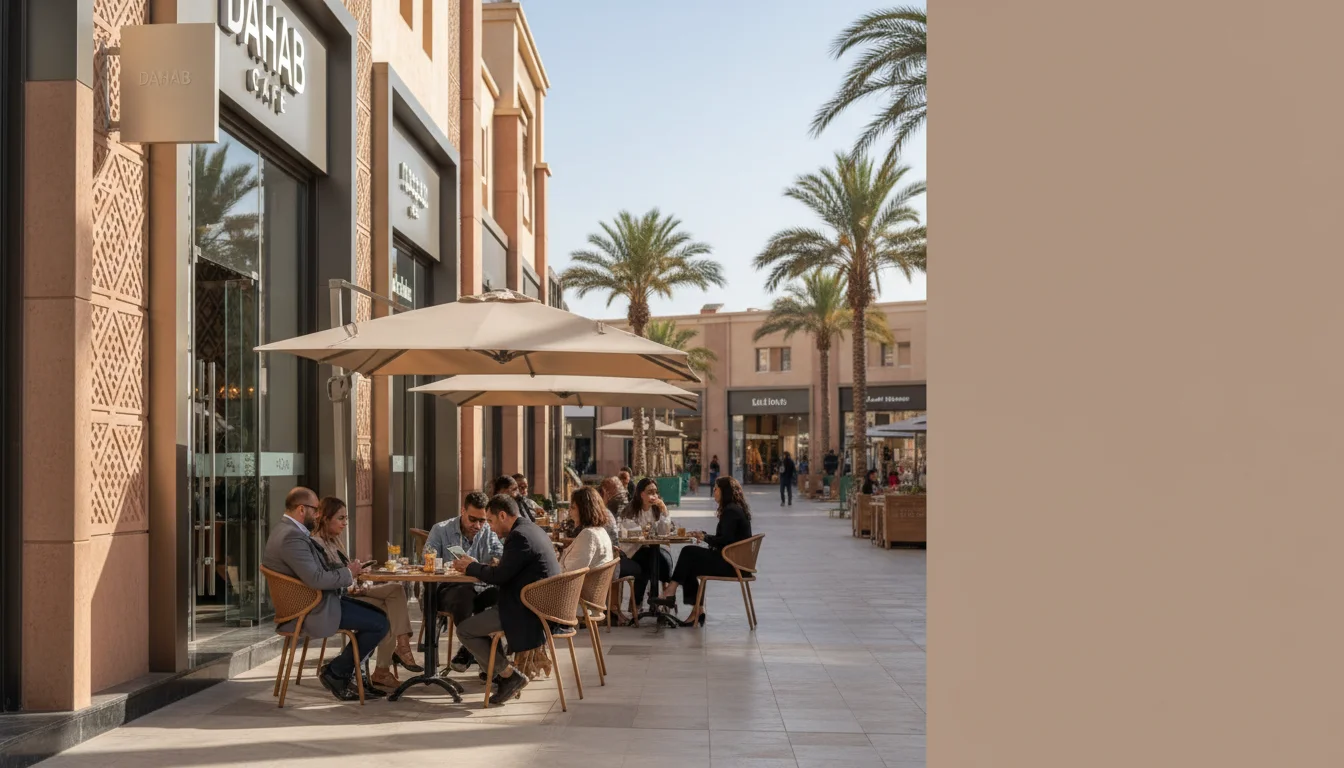
What happened: two openings take Dahab Café to 115 stores in 26 cities
One Retail has taken its Dahab Café network to 115 points of sale across 26 Moroccan cities, with two new openings in El Jadida and at Casablanca Finance City (CFC). The announcement, reported this week, frames the two sites as a continuation of the platform's build-out in Food & Beverage rather than a one-off expansion push.
The pairing of locations is the most informative detail in the release. El Jadida is a mid-sized coastal city on the Casablanca periphery, driven by regional catchment, seasonality and domestic footfall. CFC is a concentrated, high-rent business district with captive white-collar demand during weekday hours. Opening both in the same cycle tells the market that One Retail is running at least two distinct store formats under one brand, with different rent bands, build-out costs and expected average ticket.
Context matters here. Dahab was acquired outright by Moncef Belkhayat's retail platform: Billionaires Africa reported that One Retail acquired 100 percent of Dahab, described as one of Morocco's most recognizable coffee brands, a transaction also circulated on the publication's Instagram channel. Brand communication has separately positioned Dahab as a coffee operator built on an expanding franchise model. The 115-store milestone is therefore best read as a post-acquisition acceleration of an existing franchise chassis, not the launch of a new concept.
- One Retail has expanded Dahab Café to 115 points of sale across 26 Moroccan cities, adding sites in El Jadida and Casablanca Finance City.
- The simultaneous opening of a secondary-city site and a prime business-district site signals two distinct store formats with different capex and break-even profiles.
- Dahab was acquired in full by Moncef Belkhayat's One Retail platform, so the current growth is an acceleration of an existing franchise system rather than a new concept launch.
- In Moroccan secondary cities the binding constraint on F&B unit economics is typically occupancy and supply-chain cost per unit, not consumer willingness to pay.
- Smaller sponsors should underwrite each site standalone, price brand-standard costs explicitly, and model the downside as a lease exit rather than an equipment write-off.
MAD 1.5m to 3.5m (approx. EUR 135,000 to 320,000)
Indicative fit-out capex per unit
Illustrative modelling range spanning secondary-city to prime business-district formats, not published company data.
Why it matters for investors
For capital allocators, the signal is not the store count. It is that a well-capitalised platform has concluded that Morocco's secondary cities now clear the hurdle rate for branded coffee retail. That conclusion carries several implications.
First, the unit economics debate has shifted from demand to cost of occupancy. Morocco F&B franchise unit economics in cities such as El Jadida are rarely constrained by whether consumers will pay for branded coffee; they are constrained by rent per square metre, staffing depth, supply-chain frequency and the fixed cost of brand standards. A 115-store network in 26 cities implies the operator has solved the logistics and training cost per unit well enough to make smaller catchments viable. That is the real barrier to entry for a new entrant with five stores.
Second, format discipline is now a competitive moat. Running a CFC flagship-style site and a regional-city site inside the same brand requires two different capex envelopes and two different break-even assumptions. Investors evaluating F&B assets in Morocco should expect to be shown a blended P&L and should insist on cohort-level disclosure by format and vintage instead.
Third, consolidation risk is rising for independents. Once a national player can absorb the fixed cost of marketing, procurement and compliance across 115 units, the independent café in a secondary city competes on location and loyalty alone. For private investors, that argues for either taking a franchise position inside a proven system or targeting adjacent segments such as roasting, cold chain, packaging and equipment servicing, where the network build-out creates derived demand.
Finally, the transaction history matters for exit planning. A platform that has already bought a recognisable brand outright is a credible acquirer of smaller regional chains, which creates a realistic trade-sale route for sub-scale operators that build clean books. Our market research and intelligence work typically starts with exactly this question: who is the natural buyer at exit.
Data context: what 115 stores across 26 cities actually implies
Only a narrow set of hard figures is publicly confirmed, so the discipline here is to separate what is reported from what is inferred.
Confirmed: 115 points of sale, 26 cities, two new openings at El Jadida and CFC, and the full acquisition of Dahab by One Retail as reported by Billionaires Africa. Everything else below is an indicative estimate for modelling purposes, not a published fact.
Simple arithmetic gives an average of roughly 4.4 stores per city. That average almost certainly masks heavy concentration: in most Moroccan branded-retail networks, Casablanca and Rabat account for a disproportionate share of units, meaning a material number of the 26 cities are likely served by one or two sites. For an investor, that is the interesting part, because single-site cities are the test cases that determine whether the next 50 units are accretive or dilutive.
The table below sets out an illustrative framework only. The figures are indicative ranges used to show how Morocco F&B franchise unit economics diverge by format, and should not be read as Dahab Café's actual numbers.
| Indicative driver | Prime business district (CFC type) | Secondary city (El Jadida type) |
|---|---|---|
| Fit-out capex per unit (illustrative) | MAD 2.5m to 3.5m (approx. EUR 230,000 to 320,000) | MAD 1.5m to 2.2m (approx. EUR 135,000 to 200,000) |
| Rent as share of revenue (illustrative) | High single digits to low teens | Mid to high single digits |
| Demand pattern | Weekday, office-hour concentrated | Evening and weekend weighted, seasonal |
| Primary risk | Occupancy cost and weekend dead time | Catchment depth and ticket ceiling |
Two points follow. A lower capex base in secondary cities can offset a lower average ticket, which is precisely why networks expand outward once central markets saturate. And currency framing matters for foreign investors: all franchise fees, rent and payroll are MAD-denominated, while equipment and certain inputs are import-linked, so margin is partly a function of exchange-rate and import-cost exposure. Readers can stress-test their own assumptions using our investment simulator.
Strategic takeaway for investors and advisors
Treat the 115-store milestone as a site-selection benchmark, not a valuation input. The practical use of this news is that it narrows the list of cities where branded F&B has been validated by a player with real balance-sheet discipline. If a national operator is committing capital to El Jadida, a smaller sponsor can underwrite a comparable catchment with less demand-side guesswork, while remaining honest that it lacks the procurement scale behind those numbers.
Three actions follow for anyone building a position in the sector:
- Underwrite each site standalone, with its own rent, ramp curve and break-even month, before any portfolio blending.
- Quantify the cost of brand standards, including fit-out specification, equipment, training and royalty, as a share of pre-opening capex.
- Model the downside case as a lease exit, since in F&B the lease, not the equipment, is usually the binding liability.
For franchise candidates, the decision is between buying into a system with proven multi-city logistics or building an independent concept with higher margin and far higher execution risk. For institutional investors, the more capital-efficient exposure may sit upstream in roasting, distribution and cold chain. Either route needs clean structuring from the outset, which is where financial advisory and structuring and market entry support determine whether a viable concept becomes a viable asset.
Conclusion and next steps
One Retail's move to 115 Dahab Café outlets across 26 Moroccan cities, confirmed by the El Jadida and Casablanca Finance City openings, is a concrete data point in a sector where reliable operating data is scarce. It indicates that branded coffee retail in Morocco has moved past the metropolitan-only phase and that Morocco F&B franchise unit economics can work outside Casablanca and Rabat, provided occupancy cost and supply frequency are controlled. What it does not do is guarantee that outcome for a sub-scale entrant.
If you are assessing a franchise position, a regional roll-out, or an upstream supply play, the next step is a site-level model built on verifiable local inputs rather than national averages. Speak to our team through the contact page, or review the full services overview. This brief is informational and is not financial advice; indicative figures are illustrative modelling ranges, not published company data.

The information provided by Smart.by on the website www.smartbyllc.com is for informational purposes only and does not constitute financial advice. Please contact us to learn more.
Financial Insights, News & Resources
Trusted by 300+ subscribers.


Simplifying complex financial decisions through FAQs.
End-to-end investment advisory: capital allocation, risk assessment, M&A, and asset optimization, plus dedicated support for foreign investors entering Morocco, including market research, regulatory navigation, and operational setup. Every engagement is backed by Smart Flow, our real-time investment analytics platform.
High-net-worth investors, private equity and venture capital firms, and corporations expanding into Morocco and Africa. What they share is a preference for data over guesswork, and results over reassurance.
Book a consultation through our website, or call or email us directly. We'll map your objectives to a plan in that first conversation, no lengthy onboarding required.
Your investment, visible in real time. Smart Flow tracks project progress, surfaces risk before it becomes a problem, and puts financial reporting and team collaboration in one place, so you're never waiting on a quarterly update to know how things stand.
Tourism, industrial manufacturing, agribusiness, transport and logistics, automotive, and real estate: sectors we've worked in long enough to spot the risks and opportunities others miss.
Capital that's put to work deliberately, risk that's managed rather than discovered, and a market entry that doesn't stall on paperwork. Our clients measure success in returns, not activity.
Encrypted, access-controlled, and independently audited on a regular basis. Your investment data gets the same rigor as your investment strategy.
Always. We manage the asset, not just the deal: ongoing performance monitoring, risk management, and strategic adjustments as the market moves.
Subscribe to our newsletter for market insight and new opportunities as they open, or follow us on social media for real-time updates.
It's built in, not bolted on. We weigh environmental, social, and governance factors alongside financial ones, because long-term value and responsible investing aren't in competition.
Call +212 6 41 52 96 83, or visit us in Tangier, Casablanca, or Marrakech. You can also reach our team anytime through the contact page.

Still have questions before you commit?
- Talk to a consultant, not a call center
- See your numbers on Smart Flow before you decide