

Morocco added to multinational fighter helmet support contract
Pentagon contract inclusion
Reported by Hespress English; signals U.S. DoD validation of Moroccan defense-grade industrial capacity.
Over 7 million TEU annually (indicative estimate)
Tanger Med container capacity
Makes Tanger Med Africa's largest container port and a top Mediterranean logistics hub.
0% for first 5 years, 20% thereafter
Free zone corporate tax rate
Standard incentive in Morocco's Industrial Acceleration Zones, applicable to defense logistics operations.
140+ companies in Morocco
Aerospace cluster size
Established ecosystem across Nouaceur, Kenitra, and Tanger zones; provides supplier base for defense logistics corridor.
How Tanger Med and Kenitra free zones position Morocco as a defense logistics hub for NATO-adjacent supply chains. Data-backed sector outlook for investors.
Executive Summary
Morocco is quietly assembling the infrastructure, trade agreements, and industrial policy required to serve as a credible logistics corridor for Western defense supply chains. The convergence of three factors makes this opportunity timely: the Pentagon's recent inclusion of Morocco in a multinational fighter helmet support contract, as reported by Hespress English, signals growing U.S. confidence in Moroccan industrial capacity for defense-grade components. Second, Tanger Med's expansion into one of the Mediterranean's largest port complexes, combined with the Kenitra and Atlantic Free Zone industrial acceleration zones, provides the physical backbone for high-value, time-sensitive logistics flows. Third, NATO's post-2022 emphasis on supply chain resilience and geographic diversification away from single-source dependencies in Asia creates structural demand for nearshore production and logistics nodes in politically stable, treaty-aligned countries.
For international investors, defense-adjacent logistics operators, and Moroccan industrial groups seeking to move up the value chain, the question is no longer whether Morocco can participate in Western defense supply chains but how quickly the ecosystem matures and which entry points offer the best risk-adjusted returns. This article maps the market trajectory, regulatory incentives, regional benchmarks, and practical entry strategies for capital allocators evaluating Morocco's defense logistics corridor.
- The Pentagon's inclusion of Morocco in a multinational fighter helmet support contract validates Moroccan industrial capacity for defense-grade logistics and manufacturing.
- Tanger Med and Kenitra free zones offer a dual-site logistics model with zero corporate tax for five years, duty-free imports for re-export, and direct maritime access to NATO markets within one to two shipping days.
- Morocco's U.S. FTA (in force since 2006) and Major Non-NATO Ally status are material differentiators versus regional peers like Tunisia and Egypt for defense supply chain participation.
- The defense logistics corridor is early-stage; investors should model conservative ramp-up scenarios and invest in compliance infrastructure (ITAR, export controls) as a prerequisite for contract capture.
- Smart.by's advisory services span market entry, financial structuring, and risk management for investors seeking to position in this corridor before it reaches full maturity.
Since 2006
U.S. FTA in force
Provides duty-free access to the U.S. market for qualifying Moroccan-origin goods, a key differentiator for defense supply chain participation.
Defense Logistics Market Size & Growth Drivers
Sizing Morocco's defense logistics market precisely is challenging because the segment sits at the intersection of broader logistics, aerospace manufacturing, and defense procurement, none of which are reported as a single line item in official statistics. What can be established with reasonable confidence is the following framework.
Morocco's overall logistics sector is estimated to represent roughly 5% to 6% of GDP, with the government's national logistics strategy targeting a reduction in logistics costs from an indicative 20% of GDP toward 15% over the medium term. The country's aerospace and defense manufacturing exports have grown significantly over the past decade, with Morocco now hosting over 140 aerospace companies, many clustered in the Nouaceur free zone near Casablanca and in the Kenitra free zone. The defense component of this ecosystem is smaller but accelerating, driven by Morocco's own military modernization program and, increasingly, by integration into multinational defense supply chains.
The Pentagon's decision to add Morocco to a multinational fighter helmet support contract is a concrete data point. While the contract value attributable to Morocco has not been publicly disaggregated, the significance lies in the qualification itself: U.S. Department of Defense procurement standards require rigorous vetting of manufacturing sites, logistics chains, and quality management systems. Morocco's inclusion signals that at least one Moroccan facility has passed these thresholds, creating a precedent for follow-on contracts.
Growth drivers for the defense logistics corridor include:
- NATO supply chain diversification: The alliance's 2022 Strategic Concept and subsequent procurement guidance emphasize resilient, geographically distributed supply chains. Morocco's proximity to Southern Europe (14 km across the Strait of Gibraltar) and its Major Non-NATO Ally status with the United States position it as a natural nearshore node.
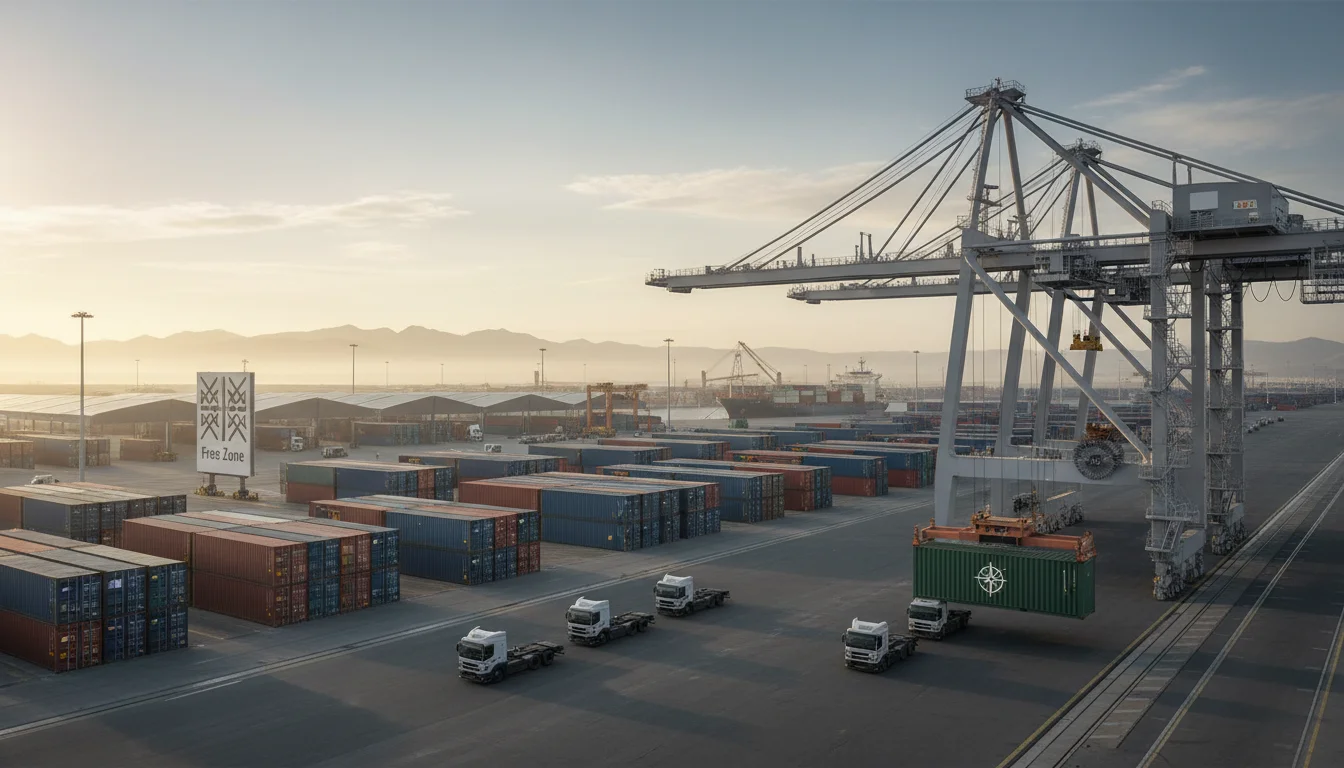
- Tanger Med capacity expansion: Tanger Med port now handles over 7 million TEU annually (indicative estimate based on recent port authority reporting), making it Africa's largest container port and a top-tier Mediterranean hub. The adjacent Tanger Free Zone and Tanger Automotive City provide warehousing, assembly, and customs-bonded logistics infrastructure.
- Kenitra's aerospace and defense cluster: The Atlantic Free Zone in Kenitra hosts aerospace manufacturers and is increasingly attracting defense-adjacent firms. Its inland location, connected to Tanger Med by motorway and rail, offers a dual-site logistics model: production in Kenitra, export through Tanger Med.
- Morocco's bilateral defense agreements: Morocco maintains defense cooperation agreements with the United States, France, the United Kingdom, and several other NATO members, providing a diplomatic framework that underpins commercial logistics flows.
While no single authoritative figure captures the total addressable market for defense logistics in Morocco, an indicative framing is useful. If Morocco's aerospace and defense exports reach an illustrative USD 2 billion to USD 3 billion annually over the next five years (a trajectory consistent with government ambitions and current growth rates in the broader aerospace cluster), the logistics component, encompassing freight, warehousing, customs brokerage, and value-added services, could represent 8% to 12% of that value, or roughly USD 160 million to USD 360 million annually. This is an illustrative estimate, not a hard forecast, but it provides a working range for investment sizing.
Regulatory & Incentive Framework
Morocco's investment environment for logistics and defense-adjacent manufacturing is shaped by several overlapping policy instruments. The most relevant for this corridor are the free zone regimes, the 2022 Investment Charter, and sector-specific incentive programs.
Industrial Acceleration Zones (formerly free zones): Morocco's free economic zones, now officially termed Industrial Acceleration Zones (Zones d'Accélération Industrielle, or ZAI), offer a standardized incentive package. Companies established within a ZAI benefit from a corporate tax exemption for the first five years of operation, followed by a reduced rate of 20% thereafter. Value-added tax and customs duties on imported inputs destined for re-export are generally exempt. The Tanger Free Zone, Tanger Automotive City, and the Atlantic Free Zone in Kenitra all operate under this regime. These zones are managed by dedicated operators (such as TMSA for Tanger Med zones and the relevant zone management companies for Kenitra) under the oversight of the national free zone authority.
2022 Investment Charter (Charte de l'Investissement): Morocco's updated Investment Charter, enacted in late 2022, introduced a tiered incentive system based on job creation, regional development impact, and sectoral priority. Logistics and aerospace are among the sectors eligible for enhanced state support, including direct subsidies covering a portion of land acquisition, infrastructure, and training costs. The charter also streamlined the role of regional investment centers (Centres Régionaux d'Investissement, or CRI) as single-window interfaces for investors.
Defense-specific considerations: Morocco does not maintain a publicly detailed, standalone incentive regime for defense manufacturing in the way that, for example, Turkey's defense industry support fund operates. However, defense-adjacent activities (aerospace components, technical textiles, electronics) benefit from the same ZAI and Investment Charter incentives. Companies involved in defense contracts may also benefit from offset (compensation industrielle) arrangements negotiated as part of Morocco's own military procurement, though these are handled on a case-by-case basis by the relevant procurement authority.
Customs and trade facilitation: Tanger Med's customs infrastructure supports authorized economic operator (AEO) certification aligned with World Customs Organization standards, which is increasingly a prerequisite for participation in defense supply chains where traceability and security are paramount. Morocco's free trade agreements with the EU (Association Agreement), the United States (FTA in force since 2006), and various African and Arab states provide preferential tariff treatment for goods produced in-country, including those assembled or processed in free zones, subject to rules of origin compliance.
Regional Financial Benchmarking: Morocco vs. Peers
For investors evaluating where to locate defense logistics and aerospace operations in the broader MENA and Southern Mediterranean region, Morocco competes primarily with Tunisia and, to a lesser extent, Egypt. Turkey is a more mature defense industrial base but operates at a different scale and cost structure. The comparison below focuses on the financial and operational parameters most relevant to logistics corridor investment decisions.
| Parameter | Morocco | Tunisia | Egypt |
|---|---|---|---|
| Corporate tax in free zone (first 5 years) | 0% | 0% (first 10 years in some zones) | Varies; Suez Canal Economic Zone offers reduced rates |
| Corporate tax post-incentive period | 20% | 10% to 13.5% (reduced rate) | 22.5% (standard rate) |
| Proximity to EU markets (shipping days) | 1 to 2 days (Tanger Med to Southern Europe) | 1 to 2 days (Rades/Enfidha to Southern Europe) | 5 to 7 days (Port Said to Southern Europe) |
| Major container port capacity (TEU, indicative) | Over 7 million (Tanger Med) | Under 1 million (Rades) | Over 3 million (East Port Said) |
| U.S. FTA in force | Yes (since 2006) | No | QIZ arrangement (limited) |
| Major Non-NATO Ally status | Yes | Yes | Yes |
| Aerospace cluster maturity | 140+ companies, established ecosystem | Emerging, smaller cluster | Military-focused, limited commercial cluster |
| Average industrial labor cost (indicative, monthly) | MAD 3,500 to 5,000 (approx. EUR 320 to 460) | TND 700 to 1,000 (approx. EUR 210 to 300) | EGP 4,000 to 6,000 (approx. EUR 80 to 120) |
Key financial takeaways from the benchmarking:
Morocco's principal competitive advantage is not the lowest labor cost (Egypt is significantly cheaper, and Tunisia is modestly cheaper) but rather the combination of port infrastructure, EU and U.S. trade agreements, and an established aerospace ecosystem. For defense logistics specifically, the U.S. FTA is a material differentiator: goods produced in Morocco can enter the U.S. market duty-free under qualifying rules of origin, a benefit neither Tunisia nor Egypt can match at the same breadth. This matters because defense supply chains increasingly require tariff-efficient, treaty-compliant sourcing to satisfy both cost targets and regulatory requirements.
Tunisia offers competitive tax incentives and geographic proximity to Europe but lacks a port of Tanger Med's scale, which constrains its ability to serve as a high-volume logistics hub. Egypt's Suez Canal Economic Zone is a formidable infrastructure play, but its distance from European end-users and its more complex regulatory environment reduce its attractiveness for time-sensitive, NATO-adjacent logistics flows.
From a financial structuring perspective, Morocco's combination of free zone incentives, the Investment Charter's subsidy mechanisms, and access to local debt markets (Moroccan banks are experienced in project finance for industrial zones) creates a layered financial architecture that can meaningfully reduce the effective cost of establishing a logistics operation. Investors should model the post-incentive tax rate (20%) into long-term financial projections, as the transition from the zero-rate period can materially affect IRR calculations.
Entry Strategies & Opportunities
The defense logistics corridor opportunity in Morocco can be approached through several distinct entry strategies, each aligned with different investor profiles and risk appetites.
1. Greenfield logistics platform in a ZAI: For established defense logistics operators or aerospace tier-1 suppliers, setting up a dedicated warehousing, kitting, and distribution facility within the Tanger Free Zone or the Atlantic Free Zone in Kenitra is the most direct path. This approach maximizes incentive capture and allows full control over quality management systems, which is critical for defense contract compliance. Smart.by's Market Entry & Business Setup advisory can support site selection, regulatory navigation, and incorporation within the ZAI framework.
2. Joint venture with an established Moroccan operator: For investors seeking faster market access and local knowledge, partnering with a Moroccan logistics or aerospace company already operating in the free zones reduces setup time and provides an existing workforce and client base. This is particularly relevant for mid-market investors who may not have the scale to justify a standalone greenfield operation. Due diligence on the local partner's financial health, contract portfolio, and compliance track record is essential.
3. Acquisition of an existing free zone operator: Morocco's aerospace and logistics ecosystem includes a growing number of SMEs that have achieved initial scale but require capital for expansion. Acquiring a qualified operator, particularly one already certified to defense or aerospace quality standards (AS9100, ITAR-compliant where applicable), can provide immediate access to the supply chain. Smart.by's Financial Advisory & Structuring team can assist with valuation, deal structuring, and post-acquisition integration planning.
4. Infrastructure and real estate play: Investors with a longer time horizon and a preference for asset-backed returns may consider investing in logistics real estate within or adjacent to the free zones: warehousing, cold chain facilities, or specialized storage for defense-grade components. Demand for such facilities is expected to grow as the cluster matures.
Across all strategies, the common thread is the need for rigorous market intelligence on contract pipelines, regulatory evolution, and competitive dynamics. Smart.by's research and strategy capabilities are designed to provide this foundation.
Key Risks & Mitigation
Regulatory and compliance risk: Defense supply chains are subject to export control regimes (U.S. ITAR, EU dual-use regulations) that impose strict requirements on technology transfer, end-user certification, and record-keeping. A Moroccan logistics operator handling defense components must ensure full compliance with both Moroccan law and the export control regime of the originating country. Mitigation requires investing in compliance infrastructure and, where necessary, engaging specialized legal counsel.
Geopolitical risk: Morocco's strategic positioning benefits from its Major Non-NATO Ally status and stable bilateral relations with the U.S. and EU. However, regional tensions (Western Sahara, broader North African instability) could affect investor sentiment or, in a severe scenario, disrupt logistics flows. Diversifying across multiple free zones and maintaining contingency routing through alternative ports (e.g., Casablanca) is a prudent mitigation.
Concentration risk: The defense logistics corridor is still nascent. Early entrants may face a thin contract pipeline and dependence on a small number of anchor clients. Investors should stress-test financial models against scenarios where defense contract volumes ramp more slowly than projected.
Currency and financial risk: Morocco's dirham (MAD) is pegged to a basket of EUR and USD, which provides relative stability but does not eliminate exchange rate risk entirely. Defense contracts denominated in USD or EUR create a natural hedge for export-oriented operators, but local cost inflation (wages, energy) can erode margins. Hedging strategies and careful cost indexation in contracts are advisable.
Talent availability: While Morocco produces a growing number of engineering and technical graduates, specialized defense logistics skills (ITAR compliance, hazardous materials handling, classified cargo management) are scarce. Training investment and partnerships with Moroccan universities and vocational institutes are necessary to build the talent pipeline.
Outlook: 2025 to 2028
Over the next two to three years, several developments are likely to shape the trajectory of Morocco's defense logistics corridor.
First, the precedent set by the Pentagon's fighter helmet support contract is expected to generate follow-on qualification opportunities. Once a country and its industrial base are validated within the U.S. defense procurement system, the barrier to subsequent contracts is materially lower. Morocco's inclusion in this multinational contract, as reported by Hespress English, should be understood as a gateway event rather than an isolated transaction.
Second, Tanger Med's continued capacity expansion and the development of the Nador West Med port (expected to become operational in the coming years) will add further logistics infrastructure, potentially enabling Morocco to handle larger and more complex defense cargo flows, including oversized military equipment and sensitive materials requiring specialized handling.
Third, NATO's ongoing supply chain resilience initiatives, combined with European defense spending increases driven by the post-2022 security environment, will sustain demand for nearshore production and logistics nodes. Morocco's geographic position, treaty relationships, and cost competitiveness position it to capture a share of this demand, particularly for components and subsystems rather than complete weapons platforms.
The most realistic scenario for 2025 to 2028 is one of steady, incremental growth rather than a sudden inflection. The defense logistics corridor will likely add 10 to 20 new entrants (a mix of logistics operators, component manufacturers, and service providers) to the existing free zone ecosystem, with aggregate defense-related logistics revenues growing from a low base toward the indicative range outlined earlier. The key variable is the pace at which Moroccan operators achieve the certifications and compliance standards required to participate in higher-value defense contracts.
Conclusion & Next Steps
Morocco's defense logistics corridor, anchored by Tanger Med's port infrastructure and the Kenitra and Tanger free zones, represents a credible and growing opportunity for investors positioned at the intersection of logistics, aerospace, and defense. The country's combination of geographic proximity to NATO markets, preferential trade agreements with the U.S. and EU, competitive cost structures, and an established aerospace manufacturing cluster creates a foundation that few regional peers can match in aggregate.
The opportunity is real but early-stage. Defense logistics in Morocco is not yet a mature, high-volume market. It is a corridor under construction, with the institutional, regulatory, and industrial building blocks largely in place but contract volumes still ramping. For investors with a medium-term horizon and the operational capability to navigate defense compliance requirements, the risk-adjusted return profile is attractive, particularly for those who enter before the corridor reaches full maturity and pricing reflects the opportunity more broadly.
Smart.by LLC provides end-to-end advisory for investors evaluating Morocco's defense logistics corridor, from initial market intelligence and regulatory mapping through financial structuring, site selection, and ongoing risk management. To discuss how this opportunity aligns with your investment mandate, contact our team directly.

The information provided by Smart.by on the website www.smartbyllc.com is for informational purposes only and does not constitute financial advice. Please contact us to learn more.
Financial Insights, News & Resources
Trusted by 300+ subscribers.


Simplifying complex financial decisions through FAQs.
End-to-end investment advisory: capital allocation, risk assessment, M&A, and asset optimization, plus dedicated support for foreign investors entering Morocco, including market research, regulatory navigation, and operational setup. Every engagement is backed by Smart Flow, our real-time investment analytics platform.
High-net-worth investors, private equity and venture capital firms, and corporations expanding into Morocco and Africa. What they share is a preference for data over guesswork, and results over reassurance.
Book a consultation through our website, or call or email us directly. We'll map your objectives to a plan in that first conversation, no lengthy onboarding required.
Your investment, visible in real time. Smart Flow tracks project progress, surfaces risk before it becomes a problem, and puts financial reporting and team collaboration in one place, so you're never waiting on a quarterly update to know how things stand.
Tourism, industrial manufacturing, agribusiness, transport and logistics, automotive, and real estate: sectors we've worked in long enough to spot the risks and opportunities others miss.
Capital that's put to work deliberately, risk that's managed rather than discovered, and a market entry that doesn't stall on paperwork. Our clients measure success in returns, not activity.
Encrypted, access-controlled, and independently audited on a regular basis. Your investment data gets the same rigor as your investment strategy.
Always. We manage the asset, not just the deal: ongoing performance monitoring, risk management, and strategic adjustments as the market moves.
Subscribe to our newsletter for market insight and new opportunities as they open, or follow us on social media for real-time updates.
It's built in, not bolted on. We weigh environmental, social, and governance factors alongside financial ones, because long-term value and responsible investing aren't in competition.
Call +212 6 41 52 96 83, or visit us in Tangier, Casablanca, or Marrakech. You can also reach our team anytime through the contact page.

Still have questions before you commit?
- Talk to a consultant, not a call center
- See your numbers on Smart Flow before you decide